
How to Identify the Right AI Use Case for Your Organization
Learn how to identify the right AI use case for your organization, from assessing data readiness and maturity to calculating costs and building with confidence.

Organizations are shifting from experimental AI pilots to integrating artificial intelligence into their core operational workflows. Today, nearly 88% of organizations use AI in at least one business function, reflecting mainstream adoption across industries [1]. By successfully moving past the initial hurdle of running isolated pilot projects and small proofs of concept, companies have proven AI's foundational value. Consequently, they now face a new operational reality, which is an abundance of competing ideas across different business functions.
This volume of potential applications represents a major milestone, shifting the leadership focus from simply discovering whether AI works to strategically orchestrating its expansion. Successfully navigating this progress requires treating use case selection as a deliberate, structured decision. By applying a rigorous framework to prioritize these initiatives, companies can confidently guide their momentum, ensuring they build high-adoption tools that optimize budgets and deliver clear, sustainable business value.
Identifying the optimal AI use case requires a disciplined, evidence-based approach. At Rootcode, we specialize in helping enterprises navigate this exact transition. Through our recent projects, we have seen firsthand how moving from fragmented AI ideation to delivering production-grade AI software requires aligning high business value with technical feasibility. The following structured methodology outlines how to identify, evaluate, and prioritize the right AI use cases for your organization.
Step 1: Assess Organizational AI Maturity
Before architecting specific use cases, an organization must first establish an objective baseline of its current AI capabilities. A machine learning pipeline that works flawlessly for a company with years of data infrastructure may completely overwhelm an enterprise that is just beginning its digital transformation. Matching the ambition of an AI use case to the reality of your current readiness is what separates sustainable innovation from premature scaling.
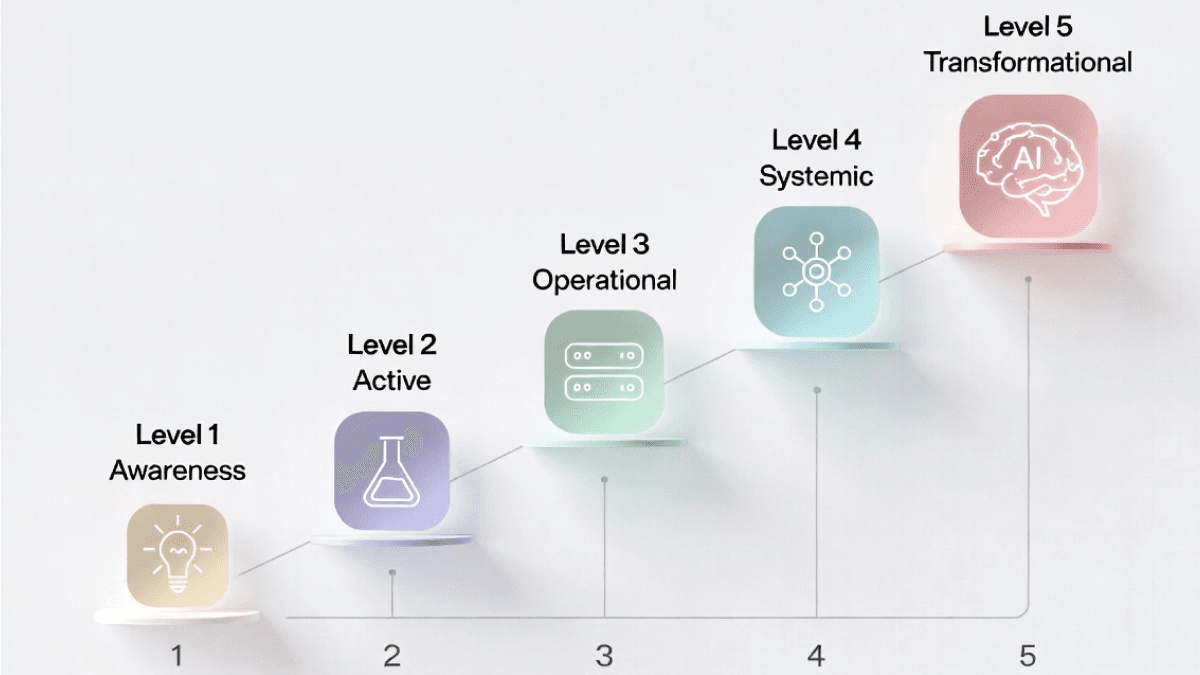
To contextualize this baseline, industry leaders often rely on frameworks like the Gartner AI Maturity Model, which categorizes organizational readiness into five progressive stages:
- •Level 1: Awareness: Organizations have a basic understanding of AI concepts but lack formal strategies or resource allocation.
- •Level 2: Active: Teams experiment with AI informally, typically running isolated pilot projects or proofs of concept without enterprise-wide infrastructure.
- •Level 3: Operational: Machine learning infrastructure is established. AI is adopted into day-to-day functions, supported by dedicated ML engineers and operational data pipelines.
- •Level 4: Systemic: AI is deployed systematically with robust governance, monitoring, and support mechanisms, actively disrupting traditional business models.
- •Level 5: Transformational: The organization has fully transformed around AI. It is not supporting the organization from the sidelines but sitting at the center of its strategy, products, and operations.
Understanding your current maturity level ensures that use case selection aligns with existing capabilities. Attempting to deploy complex, autonomous agentic AI in a Level 1 organization will inevitably lead to failure due to a lack of underlying operational and data infrastructure .
Step 2: Evaluate Data Readiness
AI models are primarily dependent on the data they process and observe. Overestimating data quality is a primary cause of project delays, as a brilliant model architecture or a sophisticated API integration cannot overcome a fractured data foundation. In the modern enterprise landscape, AI initiatives frequently rely on calling external foundational model APIs rather than training models entirely from scratch. However, data quality remains the ultimate bottleneck because accurate data is still required to contextualize, prompt, and feed into the system. Whether you are orchestrating an autonomous customer support agent that retrieves context from thousands of technical product manuals, or deploying a predictive system relying on real-time operational logs, a viable use case cannot be validated without first auditing the baseline readiness of your data.
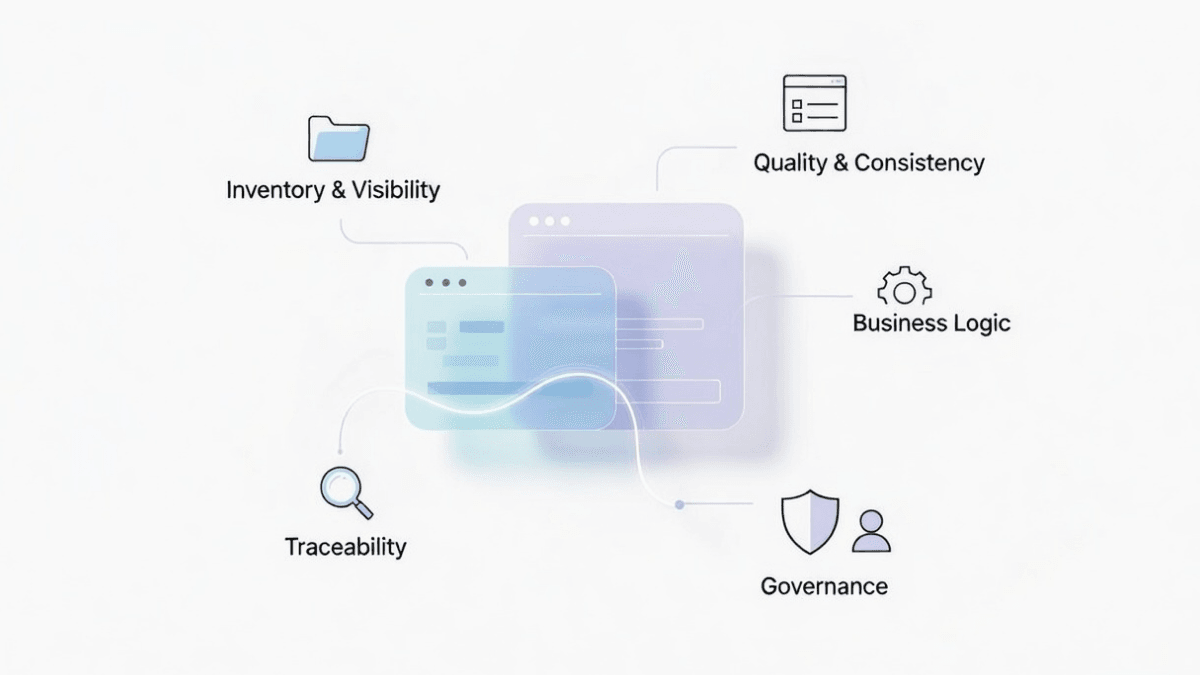
To determine if your data can support a specific AI use case, evaluate the following dimensions:
- •Inventory and Visibility: Organizations must possess a comprehensive registry of all relevant data assets, moving beyond simple database tables to encompass unstructured documents, media, and third-party feeds. To satisfy this requirement, you must know exactly what data files, formats, and historical archives exist, where they reside, and ensure each source has an understandable description of the information it contains.
- •Quality and Consistency: While AI can navigate minor data noise, it cannot operate effectively on fundamentally ambiguous, corrupt, or highly fragmented data. Meeting this requirement requires establishing clear processes to identify duplicated records, clean anomalous inputs, and actively monitor for missing values during ingestion rather than discovering data gaps by accident during production.
- •Business Logic: AI cannot automate or reason through workflows where the underlying logic remains uncodified, fluid, or purely subjective. This requires organizations to ensure that all core operational formulas, calculation rules for key business metrics, and decision-making criteria are thoroughly documented and explainable in plain language.
- •Traceability: Maintaining clear data lineage is essential for auditing system outputs, ensuring compliance, and resolving inevitable errors. This means implementing specific mechanisms to track how data transforms as it moves through your pipelines, allowing your technical team to immediately pinpoint exactly where an error or anomaly was introduced.
- •Governance: Long-term AI success relies on data that is continuously supervised and protected from decay. This is achieved by establishing explicitly defined roles and clear accountability for data owners to prevent data sources from suffering structural or semantic degradation over time.
If an organization scores poorly on a data readiness assessment, significant AI investments will not deliver the returns expected.The immediate priority must shift to building a structured data foundation.
Step 3: Apply a Strategic Scoring Model
Once organizational maturity and data readiness are established, potential AI initiatives must be filtered through a structured prioritization framework. While it is easy to view a scoring model purely as a mathematical formula, its real power lies in its ability to drive organizational alignment. This framework serves as a strategic diagnostic tool, forcing a necessary, objective conversation between technical leads and business executives. By evaluating initiatives against standardized criteria, it moves the organization away from subjective guesswork and ensures that technical capacity and commercial intent are perfectly synchronized. Ultimately, the goal is not just to generate a final number, but to ask the right questions, uncover hidden assumptions, and find the most suitable AI initiatives that can truly help the organization scale.
A highly effective method is the 3-axis scoring model, which evaluates ideas based on Business Value, Technical Feasibility, and Strategic Fit & Risk. Each dimension is scored from 1 to 5 and weighted based on organizational priorities.
1. Business Value (e.g., 50% Weight) This dimension assesses the tangible impact of the use case. Does the initiative reduce operational expenses, optimize revenue, or significantly improve the customer experience?
- •Score 1: Marginal impact; a cosmetic feature with low expected adoption.
- •Score 3: Helps a specific department improve localized KPIs.
- •Score 5: A game-changer for revenue, customer satisfaction, or market advantage. For instance, a predictive maintenance model that saves millions in equipment downtime.
2. Technical Feasibility (e.g., 30% Weight) This dimension evaluates the difficulty of implementation based on current technical resources and data availability.
- •Score 1: Very difficult; relies on unstructured data or an unclear problem definition.
- •Score 3: Medium effort; can be achieved using off-the-shelf models with minor fine-tuning.
- •Score 5: Simple implementation; high-quality internal data is readily available, and proven techniques exist.
3. Strategic Fit & Risk (e.g., 20% Weight) This dimension reviews alignment with long-term company goals and the potential operational or ethical risks.
- •Score 1: Misaligned with priorities, carrying a high risk of failure or regulatory backlash.
- •Score 5: Core to the company's mission, highly visible, and carries a low risk of failure.
By mapping the scores on a 2x2 matrix (Business Value vs. Feasibility), stakeholders can quickly identify "Quick Wins" which are projects with high value and high feasibility that should be initiated immediately.
Step 4: Calculate the Total Cost of Ownership (TCO)
A frequent oversight in AI opportunity assessment is underestimating the Total Cost of Ownership (TCO). Initial development expenses typically represent only 30% to 40% of the complete 3-year TCO.
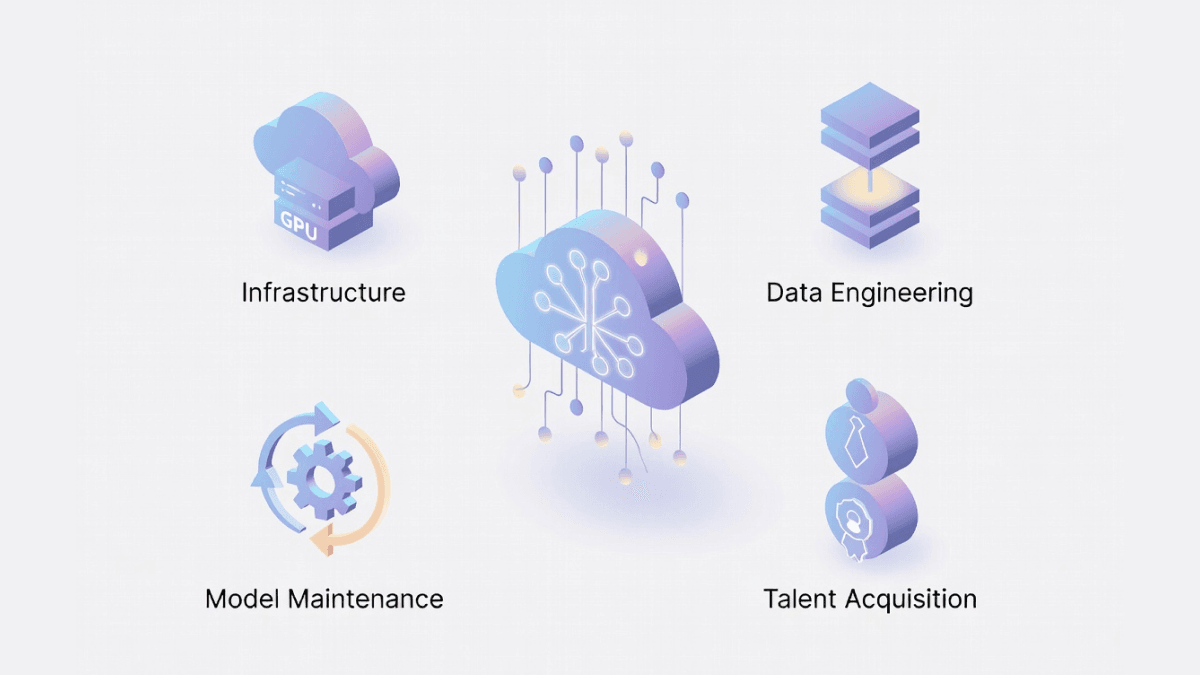
The hidden costs of AI integration fall into several categories:
- •Infrastructure: Unlike traditional software with predictable hosting, AI requires continuous computational power. Cloud infrastructure, GPUs, and vector databases (specialized databases designed to store and search data points used by AI models) can easily cost tens of thousands annually for enterprise workloads.
- •Data Engineering: Collecting, cleaning, labeling, and serving data requires real-time pipelines. This data preparation frequently accounts for up to 15% to 25% of overall AI budgets [2].
- •Model Maintenance: AI models are not static; they suffer from "model drift," where performance degrades as real-world data evolves. Maintaining accuracy through continuous monitoring and retraining adds 15% to 30% to operational costs each year.
- •Talent Acquisition: Building production-grade AI requires specialized talent, including MLOps engineers and AI security specialists, who require high market salaries.
Accurately modeling the TCO upfront prevents organizations from abandoning AI projects post-launch due to unexpected operational strains.
Step 5: Start Small with a Minimum Viable Product (MVP)
After identifying a high-priority use case and validating the budget, the execution phase should begin with a Minimum Viable Product (MVP). An MVP is a functional, tightly scoped version of the application designed to validate the core AI features and deliver measurable business value before full-scale resources are committed. At Rootcode, we specialize in fast MVP development, allowing organizations to move quickly from an abstract concept to a working software solution that provides immediate utility.
Empirical data strongly supports starting small. Projects with smaller initial budgets (under €15,000) have been shown to achieve a median ROI of +428%, compared to +198% for projects with budgets exceeding €100,000 [3]. Large budgets frequently trigger scope creep, political complexity, and unrealistic stakeholder expectations.
A successful MVP must define key performance indicators tied directly to clear business outcomes, such as prediction accuracy, processing speed, user satisfaction, or cost savings. Because an MVP serves as the foundation for future growth, Rootcode structures these initial versions to transition seamlessly into production-grade enterprise software. This is achieved by shifting away from static datasets to automated data pipelines, integrating robust MLOps frameworks, and designing highly scalable architectures.
Step 6: Establish Governance and Human-in-the-Loop Controls
Moving an AI use case to production requires addressing operational risk, safety, and complex compliance liabilities. Implementing a structured governance model is mandatory to safeguard the organization against evolving regulatory frameworks, data privacy violations, and industry-specific legal penalties. The NIST AI Risk Management Framework provides a highly regarded methodology based on four core functions: Govern, Map, Measure, and Manage. This framework ensures organizations cultivate a risk-aware culture, understand the exact regulatory context of their AI systems, assess potential compliance hazards, and apply procedural safeguards.
To maintain agility without sacrificing oversight, modern governance must rely on automated processes embedded directly into the deployment pipeline. Rather than treating governance as a manual checkpoint that slows down innovation, organizations should deploy automated guardrails. These include real-time model drift detection, automated bias monitoring, and programmatic data validation gates. By automating these compliance checks, technical teams can continuously audit system inputs and outputs, automatically flagging anomalies before they present financial or reputational risks.
Alongside automation, a highly effective practice within AI governance is the "Human-in-the-Loop" (HitL) model. This protocol requires AI outputs to receive human validation before any critical or high-stakes action is executed. Deployments utilizing HitL governance experience fewer critical operational incidents and achieve a higher median ROI compared to fully autonomous AI setups, because human oversight effectively mitigates compliance risks, prevents costly algorithmic errors, and builds long-term organizational trust.
Proven AI Use Cases by Industry
Analyzing established patterns can help organizations validate their use case selection. In our projects, we have noted that the most successful implementations target specific, detailed workflows where AI's capabilities offer a clear advantage over traditional automation:
Financial Services Financial institutions heavily prioritize risk management, fraud detection, and complex document processing.
- •Mergers & Acquisitions (M&A): Generative AI has transformed the M&A due diligence process. By rapidly analyzing vast data rooms, AI cuts deal timelines by 10% to 30% and reduces overall M&A transaction costs by roughly 20% [4]. This level of success is achieved by deploying the system within entirely closed, private infrastructure to safeguard market-sensitive information. Furthermore, organizations validate the model against historical, finalized deals. This ensures its extraction accuracy matches rigorous human standards before live deployment.
- •Agentic Document Vetting: Banks utilize agentic AI systems to execute multi-step compliance verifications. For example, they cross-reference bank guarantees and complex legal contracts against shifting regulatory frameworks. These systems extract deep contextual data, map it against compliance rules, and surface exceptions to legal experts. The speed and safety of this workflow rely on establishing a comprehensive repository of core business logic upfront. It also utilizes a Human-in-the-Loop model. This ensures the AI operates as an advanced filtering layer rather than an autonomous decision-maker, which removes legal liability and avoids costly regulatory penalties.
Manufacturing & Supply Chain The industrial sector leverages AI primarily for physical asset management and workflow optimization.
- •Predictive Maintenance: By applying machine learning models to real-time IoT sensor data, such as vibration, temperature, and pressure, companies can anticipate equipment failures before they occur, significantly reducing unplanned factory downtime and extending the lifespan of expensive machinery. Achieving this outcome requires building robust data pipelines capable of filtering out high-frequency sensor noise, combined with continuous model drift monitoring so the technical team can update the AI's baseline parameters as physical equipment naturally degrades over time.
- •Computer Vision Quality Control: Industrial companies integrate high-speed cameras directly into assembly lines, running specialized computer vision models trained to detect micro-defects in real time with a level of speed and precision that surpasses human capability. This technology can reduce assembly failures by up to 70% and increase visual inspection accuracy by 80% [5]. Teams secure these positive milestones by launching a Minimum Viable Product (MVP) on a single production line with predictable error types and strictly structuring their data readiness, specifically ensuring thousands of defect images are precisely labeled to train the model accurately.
Retail and E-Commerce In retail, AI focuses on hyper-personalization at scale and intelligent inventory management.
- •Inventory Optimization: AI platforms analyze real-time sales trends, regional consumer behaviors, and external factors like weather patterns to anticipate demand shifts. This ensures stock levels align perfectly with market needs, minimizing both surplus and stockouts. The success of this deployment relies on deep system integration. The AI must link directly with enterprise resource planning (ERP) systems and point-of-sale software. Organizations de-risk the rollout by validating the model through an MVP focused on a few high-velocity product categories before scaling it across the wider inventory catalog.
- •Store Operations & Pricing: Brick-and-mortar retailers optimize physical product placement through store analytics. At the same time, they execute dynamic pricing algorithms that adjust e-commerce and in-store digital prices in real time. These adjustments are based on competitor rates and inventory velocity. This system successfully protects profit margins because developers embed automated governance guardrails directly into the pricing logic. These guardrails set strict operational boundaries. They prevent the algorithm from triggering erratic pricing loops or violating fair-pricing regulations.
Healthcare Healthcare organizations use AI to enhance both clinical outcomes and administrative efficiency.
- •Clinical Decision Support: AI systems analyze extensive patient histories, genetic profiles, and medical imaging to identify critical health risks early. This allows medical staff to recommend proactive treatment protocols. These systems successfully earn clinician trust and improve patient outcomes because they are built with absolute data traceability and strict Human-in-the-Loop controls. This approach ensures the software acts strictly as an analytical assistant. It gives doctors a clear lineage of the historical data points that led to the specific risk flag.
- •Administrative Automation: Natural language processing pipelines extract and process unstructured data from insurance claims, intake forms, and electronic medical records. This streamlines administrative information flow and automates patient scheduling. This automation successfully minimizes manual data entry errors and accelerates patient processing. The strategy succeeds because the implementation targets highly repetitive, low-risk clerical paths first. This ensures the system handles formatting inconsistencies reliably before expanding into broader operations.
Software, IT, and SaaS Technology companies use AI to accelerate product development and optimize user experiences.
- •Software Engineering Support: Development teams utilize AI co-pilots to generate code, debug software bugs, and search internal documentation. This significantly compresses the software development lifecycle. Organizations unlock the full value of this tool by embedding automated code-quality checks and security vulnerability scans directly into their deployment pipelines. This ensures that every AI-generated suggestion undergoes rigorous technical oversight before going live. As a result, companies maximize developer velocity without compromising software security.
- •Customer Success & Sales Automation: SaaS companies implement predictive analytics for automated lead scoring, churn prediction, and intelligent product routing to preserve recurring revenue. In many Rootcode deployments, integrating product intelligence and predictive analytics provides clients with immediate value for roadmap prioritization. This success is achieved by unifying disparate data sources, such as user interaction telemetry, support ticket histories, and billing data. Unifying these streams allows the AI to accurately pinpoint underlying friction patterns so leadership can proactively implement retention strategies.
Case Study: Building the AI Foundation at Nefab
Rootcode partnered with Nefab Group, a global industrial packaging company with over 75 years of engineering history operating across 38 countries. The engagement began with a 3-day requirement gathering workshop to identify the right use cases. Nefab's leadership knew they wanted to adopt AI but did not have a clear view of where it could deliver the most value, and the workshop was designed to bridge that gap. Rootcode engaged directly with Nefab's sales, engineering, and management teams to map their workflows and surface the pain points that mattered most. One of the most significant was the time designers spent generating initial packaging concepts, which previously took one to two weeks. From there, Rootcode helped Nefab broaden their view of what AI could realistically achieve and shortlisted the most impactful use cases, structuring them into a phased roadmap.
With the use cases identified, Rootcode ran a structured 3-week data audit to assess the quality and accessibility of decades worth of operational data. Given the organization's scale and history, data existed in abundance, but its readiness for AI had not yet been validated. Nefab provided access to their data sources which Rootcode then assessed for quality, completeness, and usability for AI training.
The audit was critical in shaping the direction of the engagement. It informed not only which use cases to move forward with, but also granular decisions within those use cases. Nefab works across a wide range of industries and packaging categories, each with its own design considerations and data characteristics. With millions of design records accumulated over decades, deciding where to focus first for an MVP required clear evidence from the data, not assumptions. The audit provided exactly that.
The first use case to come out of this process is an AI assistant being built directly into the design tool used by Nefab's engineers, enabling them to generate design variations from a customer requirement in 20 to 30 minutes instead of weeks.
The engagement is structured as a phased roadmap, with each phase evaluated against clear deliverables before moving on to the next. This approach keeps the project tightly scoped, accountable, and aligned with measurable business outcomes. None of it would have been possible without the structured requirement gathering and the data audit at the start, which together gave Rootcode and Nefab a shared understanding of where the real pain points were, what the data could support, and where to begin building with confidence.
Conclusion
In 2026, the competitive divide is no longer between organizations that use AI and those that do not. The divide is between companies that scale AI effectively to deliver enterprise-wide value and those that remain stuck in a cycle of unprofitable pilot programs. Identifying the right AI use case is not a simple task. It requires assessing organizational maturity, ensuring strict data readiness, calculating the true Total Cost of Ownership, and scoring initiatives based on business value and feasibility. By starting with tightly scoped Proofs of Concept and maintaining Human-in-the-Loop governance, companies can mitigate risk and increase their return on investment. Rootcode partners with organizations to navigate this exact architecture. No matter the industry, our teams move quickly to understand the domain, engage with complex workflows, and identify where AI can deliver the most value. By combining deep domain understanding with strategic use case identification and expert software engineering, our projects ensure that your AI investments translate into reliable, scalable systems that solve real business problems and drive long-term operational success.
Share this article:
Rootcode Editorial
Content Specialist
The Rootcode Editorial team writes across design, AI, and engineering -bringing the perspectives and knowledge of the Rootcode team to a wider audience.
Let’s talk about how to transform your business.



Rootcode EU
Sakala tn 7-2,
Kesklinna linnaosa,
Tallinn,
Harju maakond,
10141, Estonia

Rootcode Sri Lanka
No. 42,
Level 15,
Nawam Mawatha,
Colombo 00200,
Sri Lanka




© 2026 Rootcode. All Rights Reserved