
Building the Foundation: Design Systems, Tokens & Why Every SaaS Product Needs One
Learn why every growing SaaS product needs a design system. Discover design tokens, avoid design debt, and keep your product consistent, scalable, and easy to update.
There's a moment every growing SaaS product hits. The team is bigger, the feature list is longer, and somewhere along the way the product started feeling... uneven. A Filter pane, buttons looks slightly different on two screens. A modal behaves one way in one module and another way somewhere else. The spacing feels off in places nobody can quite pinpoint. Nobody made a bad decision to get there. The product just grew faster than the system holding it together.
This is the design debt problem and it's one of the most common, most avoidable, and most underestimated challenges in SaaS product development. The solution isn't more designers or more reviews. It's a design system and specifically, one that's been built with scale in mind from the start.
This article is suitable for everyone on a SaaS product team: designers, engineers, and PMs. It covers what a design system actually is, how tokenization works and why it matters, what happens to products that grow without one, and what teams can do to get this right at any stage.
What a design system actually is
A design system is a shared library of reusable components, visual standards, and documented guidelines that the entire product team builds from. It's the single source of truth for how your product looks, feels, and behaves from the color of a primary button to the way an empty state communicates when a module has no data yet.
It sits in three layers, each building on the one below:
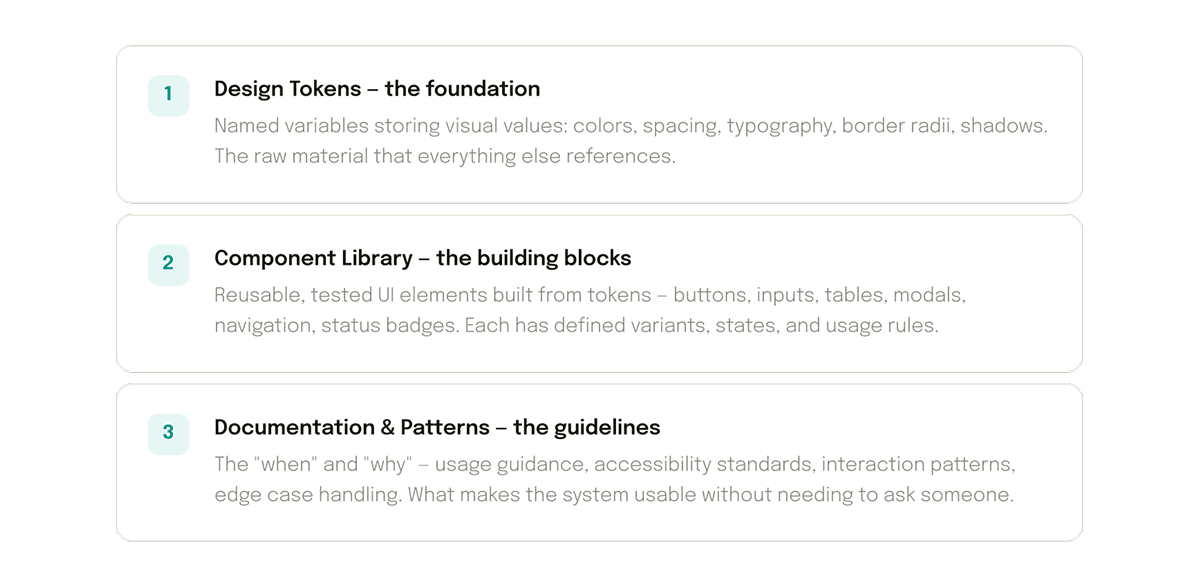
When all three layers are in sync between design files and the codebase building new features becomes faster, more predictable, and more consistent. When they drift apart, every team member starts filling the gaps with individual judgment calls. And the product slowly stops feeling like one thing.
Why SaaS products are especially Vulnerable
Most product types have a contained surface area. A SaaS platform doesn't. A typical business SaaS product spans a dashboard, onboarding flows, settings, notifications, billing, help content, mobile views, and potentially a dozen feature modules all being developed in parallel by different team members, often under deadline pressure.
Every surface is an opportunity for the product to feel cohesive or not. And without a shared system tying everything together, drift is almost inevitable.
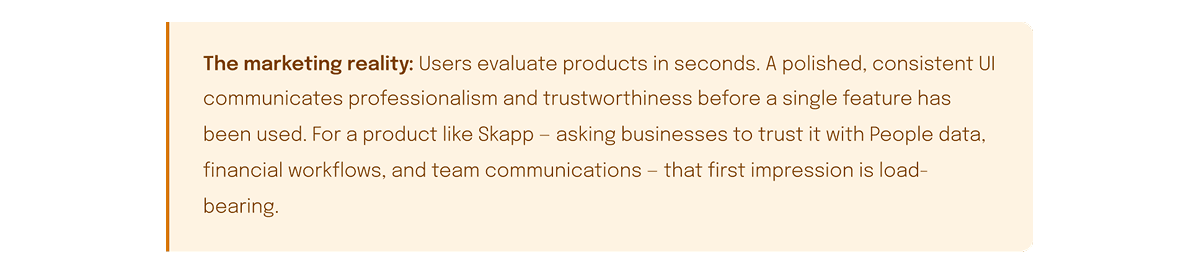
Take a real example. A product like Skapp, an AI-powered workspace that covers People management, Time Off, Time Tracking, E-Signatures, Invoicing, Project Management, CRM, and more is managing an enormous amount of UI surface area across many different functional modules. For a product like that, coherence isn't just a design value. It's a trust signal. A user moving between the People module and the Invoicing module should feel like they're in the same product, not two things that happen to share a login screen.
This is the challenge every multi-module SaaS product faces. And it's exactly the kind of challenge a well-structured design system is built to solve.
The four faces of design debt
Design debt accumulates the way technical debt does quietly, usually during periods of fast growth. It's not a character flaw in any team. It's what happens when shipping is the priority and there's no mechanism keeping the system aligned.
Here's what it looks like in practice:
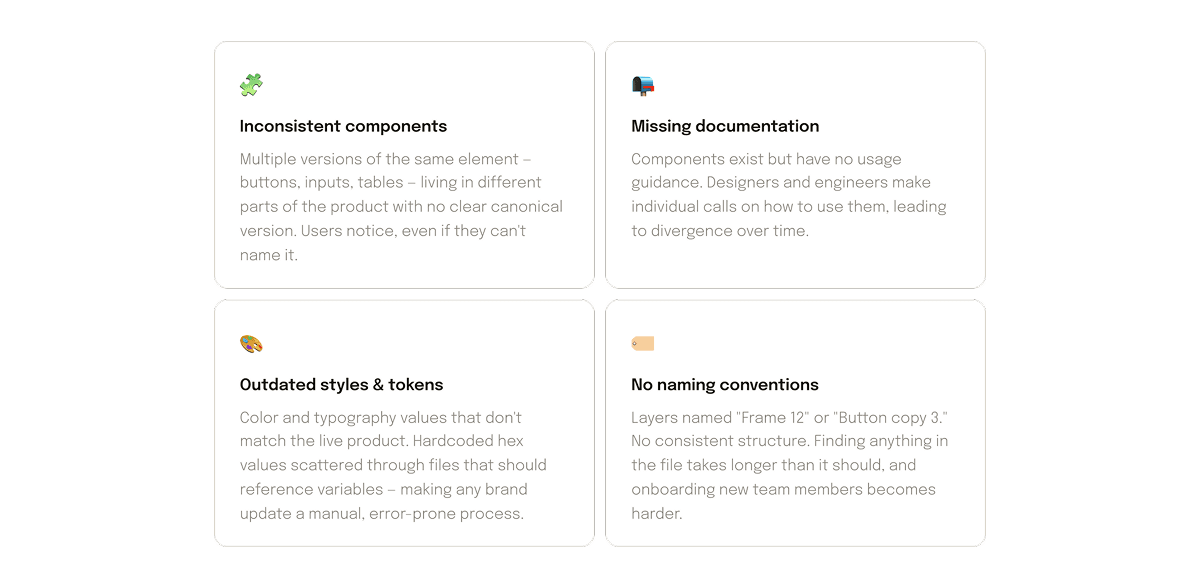
Individually, each of these is manageable. Together, they compound slowing down design, introducing friction in engineering, and gradually eroding the sense of quality that users associate with the product.
A deeper look at tokenization
Tokenization is the part of design systems that tends to generate the most questions particularly from engineers and PMs who haven't encountered it before. So let's make it practical.
A design token is a named variable that stores a visual decision. Instead of writing #2563EB every time you need a primary blue in your design file or your codebase, you define a token color.action.primary and reference that name everywhere instead.
Here's what a token layer looks like in practice:
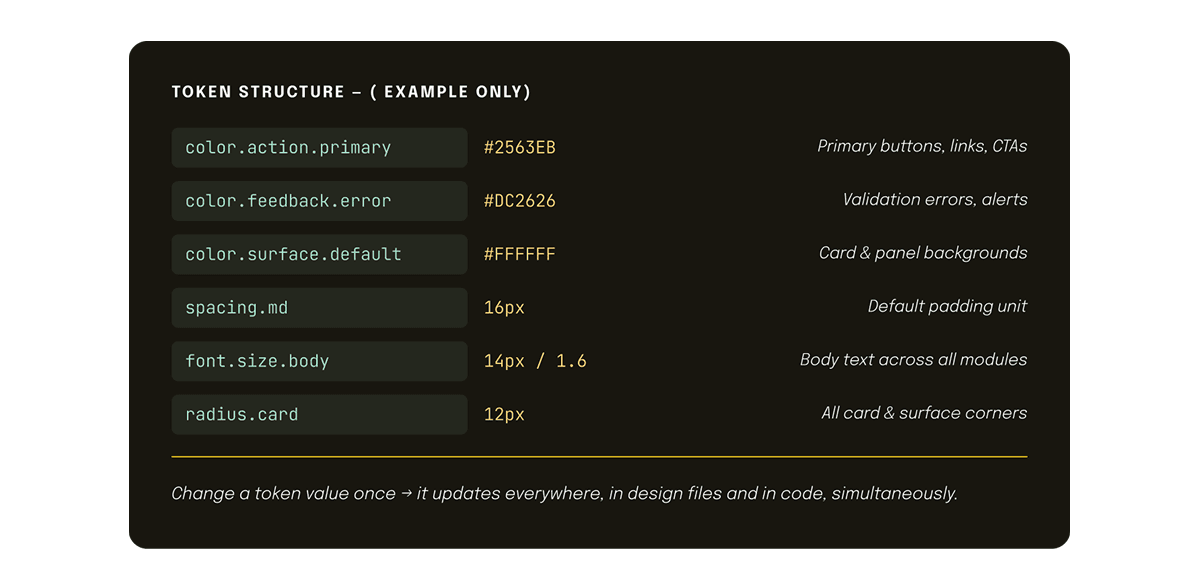
The key insight: when you change a token value, every element referencing that token updates everywhere in design files and in code simultaneously. A brand refresh that used to mean combing through hundreds of hardcoded values becomes a handful of token-level changes.
Why this matters for engineers specifically When design and code use the same token names, the handoff between a spec and an implementation becomes close to direct translation. A design that says "use color.action.primary on this button" maps straight to a CSS custom property or a theme variable in your component library. No color picking, no approximating the spec and the code are speaking the same language.
Why this matters for PMs specifically Token-based systems make visual changes fast and predictable. If a brand decision needs to change a new primary color, a refined type scale, adjusted spacing the impact of that change is contained and controllable. Without tokens, the same change is a sprawling piece of work that touches files and code across the entire product.
For any SaaS product with ambitions to grow new modules, white-label offerings, dark mode, mobile apps a token layer isn't a nice-to-have. It's the infrastructure that makes all of those things feasible without starting from scratch each time.
Lessons from reshaping a real design system
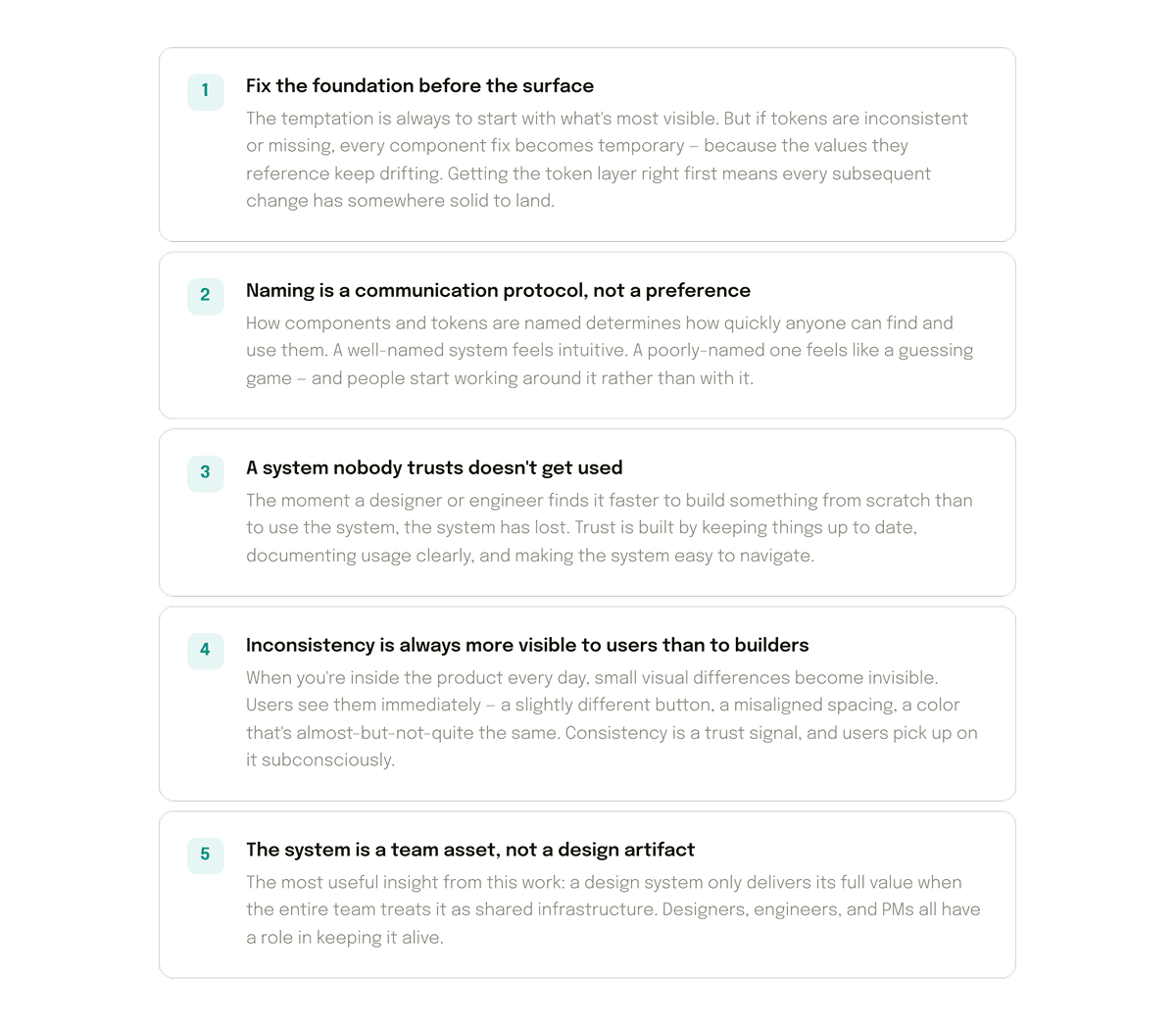
Working closely on a design system for a multi-module SaaS product over an extended period teaches you things you can't learn from documentation alone. Here are the lessons worth sharing with any product team going through similar work.
Why adherence matters as much as the system itself
A well-built design system that teams consistently bypass doesn't deliver its value. Adherence actually building from the system rather than around it is what makes the investment worthwhile.
What good adherence looks like in practice:
- •Check the component library before proposing a new component
- •Reference token names in design specs and in code, not raw values
- •Flag gaps in the system during planning, not during implementation
- •Treat documentation as the first stop, not a last resort when something is unclear
- •When an exception feels necessary, raise it explicitly one-offs quietly become de facto standards
- •Feed back what you learn if a pattern is hard to use or missing entirely, say so
What erodes a system over time:
- •Building custom UI for something the system already covers
- •Hardcoding colors, spacing, or type values directly in code
- •Silently diverging from patterns to move faster in the short term
- •Skipping documentation because it feels optional
- •Discovering during implementation that a needed pattern doesn't exist yet
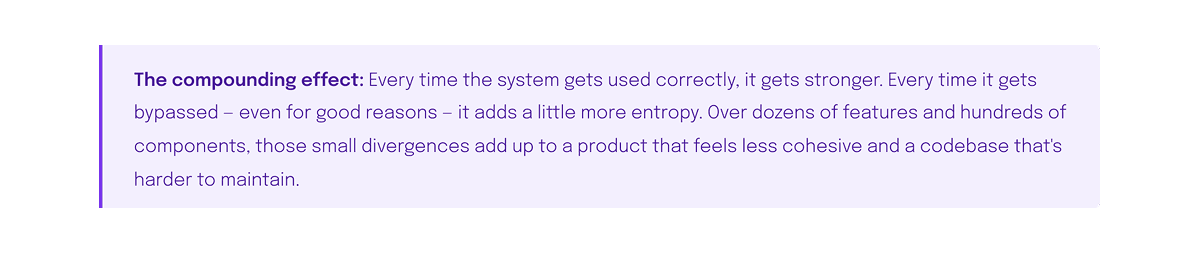
The compounding dynamic here is important.
"Design system adherence isn't a design concern. It's a product quality concern."
Getting started: what actually moves the needle
For teams earlier in this process, the most valuable thing isn't a perfect system on day one. It's starting in the right order and being consistent about it.
Start with tokens, not components Before touching the component library, establish your token layer. Define your color system, your type scale, your spacing units. Name them semantically by purpose, not by appearance. This foundation is what makes everything that follows maintainable. Document as you build, not after Documentation added retrospectively is almost always incomplete. The context for a decision is freshest at the moment the decision is made. Build documentation into the definition of done for every component, not a separate cleanup task. Treat the system as a product The design system needs an owner, a backlog, and time allocated to it in the roadmap. Not because it's glamorous work it usually isn't but because it's infrastructure. And infrastructure that isn't maintained degrades. Make adherence the path of least resistance The best design systems are the ones that are faster to use than to work around. If the system requires too much effort to navigate, people will stop using it regardless of how well it's built. Invest in the developer experience of the system itself, not just the output.
The bottom line
A design system is not a design team deliverable. It's product infrastructure is as foundational to the quality and scalability of a SaaS product as the API architecture or the data model underneath it.
For any early-stage SaaS products especially, getting this right early pays compound returns. Every feature built on a solid system ships faster. Every visual update is less expensive. Every new team member gets up to speed more quickly. And the product, over time, earns the kind of trust from users that comes from feeling like it was built by one team with a shared, coherent vision.
That's not a design goal. That's a business goal. And a design system is one of the most direct paths to getting there.
If you're encountering friction with the system, a component that's missing, a pattern that's confusing, something that seems to require a workaround that's a valuable signal. Bring it up to the design team. The best design systems evolve because of feedback from the people who use them every day to build real things.
That's all of us.
Share this article:
Dhanushka Liyanage
Let’s talk about how to transform your business.


Rootcode EU
Sakala tn 7-2,
Kesklinna linnaosa,
Tallinn,
Harju maakond,
10141, Estonia

Rootcode Sri Lanka
No. 42,
Level 15,
Nawam Mawatha,
Colombo 00200,
Sri Lanka






© 2026 Rootcode. All Rights Reserved