
What Is Agentic AI? A Practical Guide for Enterprise Leaders in 2026
Learn how agentic AI systems work, where they are delivering results in production today, and what separates enterprise deployments that scale from those that stall.
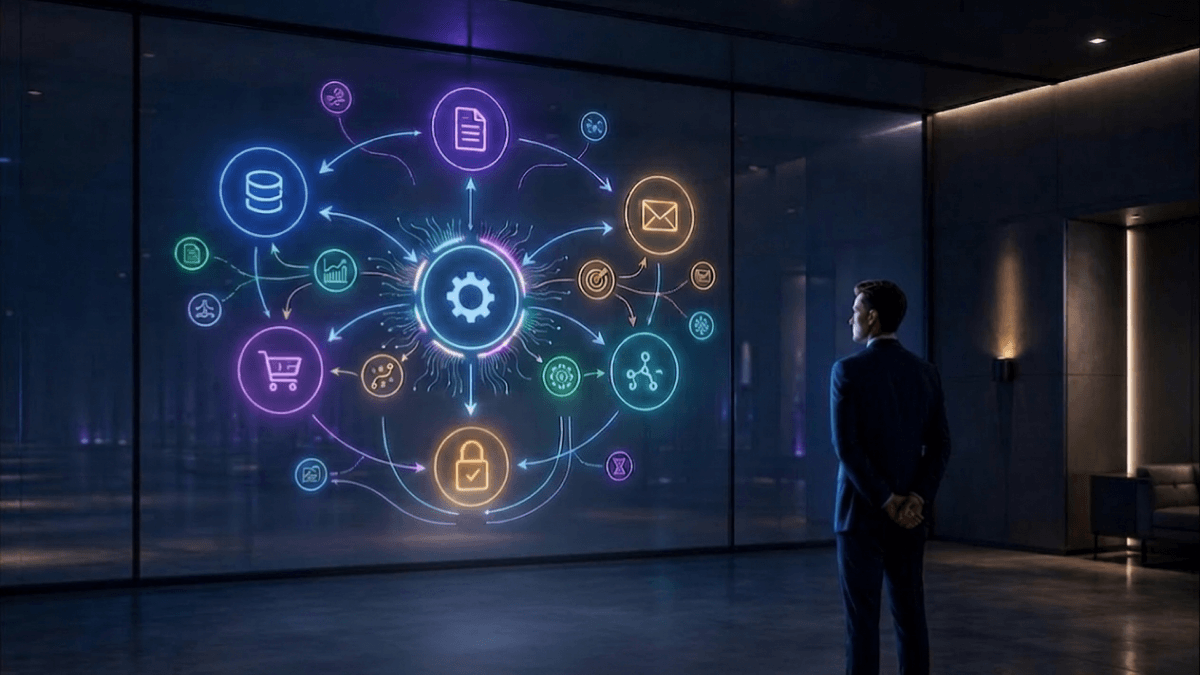
Imagine a sudden, major supply chain disruption hitting your primary logistics route.
In the recent past, enterprise AI deployments followed a familiar, fundamentally reactive pattern. A logistics manager would type a prompt: "Summarize the impact of the port delay on our Q3 inventory." The AI would process the data, generate a neat summary report, and stop. It waited to be asked, responded once, and left the heavy lifting to the human. The manager still had to spend hours logging into the ERP system to check stock levels, emailing alternative suppliers for quotes, and updating the CRM to warn high-value clients.
In 2026, Agentic AI completely flips this script.
When a disruption alert hits, an autonomous AI agent doesn’t just report the news - it actively resolves the problem. Given the high-level goal to mitigate the inventory deficit, the system independently orchestrates a multi-step solution across your enterprise ecosystem:
- •Analyzes the delayed shipment manifest to pinpoint exactly which SKUs are affected.
- •Queries the ERP to identify which downstream product lines will stall first.
- •Calls APIs of alternative suppliers to request automated quotes and check real-time availability.
- •Drafts tailored updates for affected accounts directly inside the CRM.
- •Escalates a finalized action plan to the operations director: "I have sourced 5,000 replacement units within our standard cost variance and prepared the client notifications. Approve execution?"
The Core Shift: An AI agent is a system that takes a goal, breaks it into steps, decides which tools to use at each step, acts on the results of each action, and continues until the objective is complete. It does not need to be hand-held through every single turn. It reasons, plans, and executes with an operational autonomy that traditional, conversational AI simply cannot match.
Gartner predicts that 40% of enterprise applications will include task-specific AI agents by the end of 2026, up from less than 5% in 2025 [1]. The agentic AI market is projected to reach $10.86 billion in 2026, up from $7.55 billion in 2025 [2]. Understanding what agentic AI actually is, how it works architecturally, and where it fits in an enterprise context has become a practical requirement for technology leaders.
What Makes a System Agentic
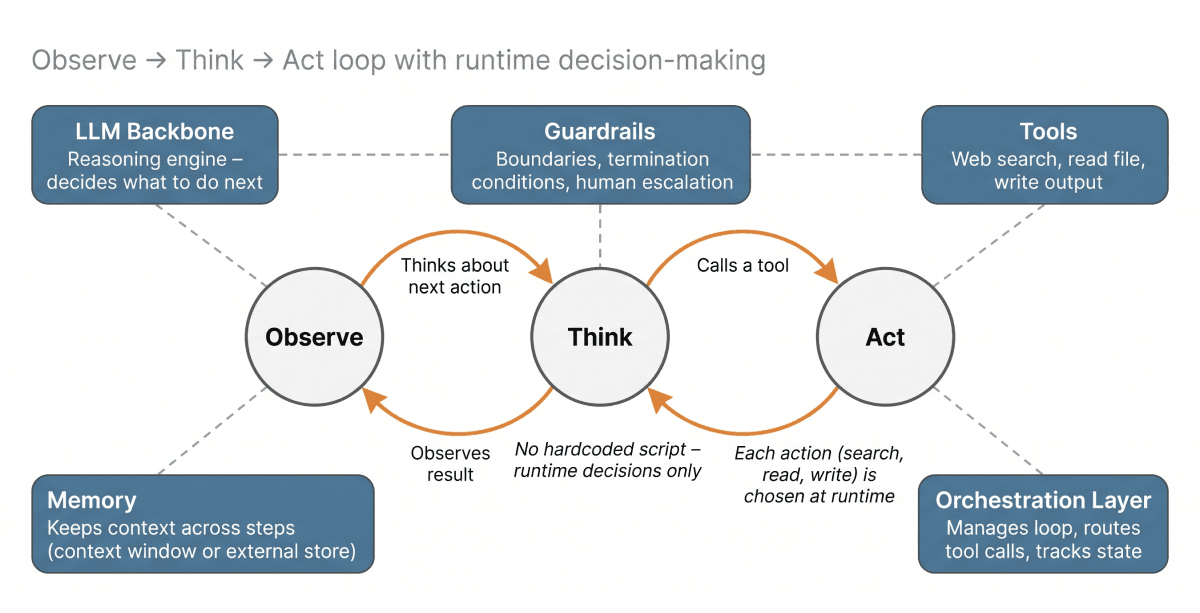
The term "agent" is used loosely across the industry, and not all AI products that claim to be agentic actually are. The clearest way to define it is through behavior: a true AI agent exhibits a planning and execution loop, uses tools to take actions in external systems, maintains some form of memory across steps, and can adapt based on what it observes at each step.
Think of an agentic AI as a system that can be handed a goal and left to figure out how to achieve it. Rather than waiting for instructions at each step, it decides what to do next, acts, observes what happened, and continues from there. To understand what that actually looks like in practice, it helps to walk through each component using a concrete example.
Say your agent is given this goal: "Research our top three competitors and prepare a briefing document."
The LLM Backbone is the reasoning engine at the center of everything. When the goal arrives, this is what decides where to start: search the web for competitor one, probably starting with their recent product announcements. It is not following a pre-written script. It is reasoning about what makes sense given the goal and what it knows so far.
Tools are what allow the agent to actually do things. Without tools, a language model can only produce text. With them, the agent can call a web search API to find competitor pages, fetch and read those pages, query an internal database to cross-reference against your company's positioning, and eventually write the output document to a file. Each of these is a discrete action the agent chooses to take based on where it is in the task.
Memory is what keeps the agent coherent across all of those steps. After searching for competitor one and extracting the key information, that result needs to be available when the agent is working on competitor three and writing the final synthesis. Memory can live in the active context window for shorter tasks, or in an external store that the agent reads from and writes to as it goes, for longer ones.
The Orchestration Layer manages the loop itself. It takes the agent's decision ("I want to call the web search tool with this query"), routes that call to the actual tool, returns the result to the agent, and tracks the overall state of the task. It also determines when the task is complete or when something has gone wrong.
Guardrails and Termination Conditions define the boundaries. The agent knows it should not access systems outside the scope of the task, that it should stop and ask a human if it reaches a decision it is not authorized to make on its own, and that the task ends when the briefing document has been written and saved.
Taken together, these components form what is called the Observe-Think-Act loop. The agent observes its current context (the goal, any results so far), thinks about what action to take next, acts by calling a tool, and then observes the result of that action. This cycle repeats until the goal is achieved or the agent determines it needs human input to continue.
Every action in the competitor research example above, searching, reading, cross-referencing, writing, was decided at runtime. None of it was hardcoded in advance. That runtime decision-making, grounded in what the agent has observed at each step, is what separates a genuinely agentic system from a predefined workflow that simply calls a model at each stage.
Multi-Agent Systems
As agentic architectures mature, the single-agent model is giving way to systems where multiple specialized agents coordinate to complete a larger goal. A multi-agent system is one where individual agents are each designed for specific tasks, such as data retrieval, calculation, summarization, or external system interaction, and an orchestrator agent coordinates their work.
This mirrors how organizations themselves operate. Different teams handle different functions, and a project manager coordinates across them. The technical advantage is that each agent can be optimized for its specific task, and the system as a whole can handle complexity that exceeds what any single agent could manage reliably.
To make that coordination work in practice, modern multi-agent systems require two distinct layers of communication: one for agents talking to each other, and one for agents talking to the external world.
Horizontal delegation: how agents coordinate with each other When an orchestrator agent needs to hand off a subtask to a specialized agent, it needs a shared language for doing so. What is the task? What context does the receiving agent need? How does the result come back? Google's Agent-to-Agent (A2A) protocol addresses exactly this. It defines a standard for how agents expose their capabilities to each other, how tasks are delegated, and how results and context are passed back across the handoff. Without something like A2A, every multi-agent system has to invent its own internal communication conventions, which quickly becomes a maintenance problem at scale.
Vertical tool access: how agents connect to the world Separately, every individual agent needs to interact with external systems to do its job: querying databases, reading files, calling APIs, updating records. Before the emergence of standard protocols, this meant writing a custom integration for every tool and every data source. An agent that needed to pull from a CRM, a data warehouse, and an internal knowledge base required three separate, bespoke connectors, each maintained independently.
Anthropic's Model Context Protocol (MCP) solves this. Often described as the "USB port" for AI agents, MCP is an open standard that defines a universal interface between an agent and any external tool or data source. Any system that exposes an MCP server can be connected to any MCP-compatible agent without custom integration work. This is why MCP has seen adoption at a scale that most developer protocols never reach: 97 million installs in early 2026, with support from every major AI provider. It eliminated a genuinely painful problem.
A2A and MCP are not competing standards. They operate at different layers and are designed to be used together.
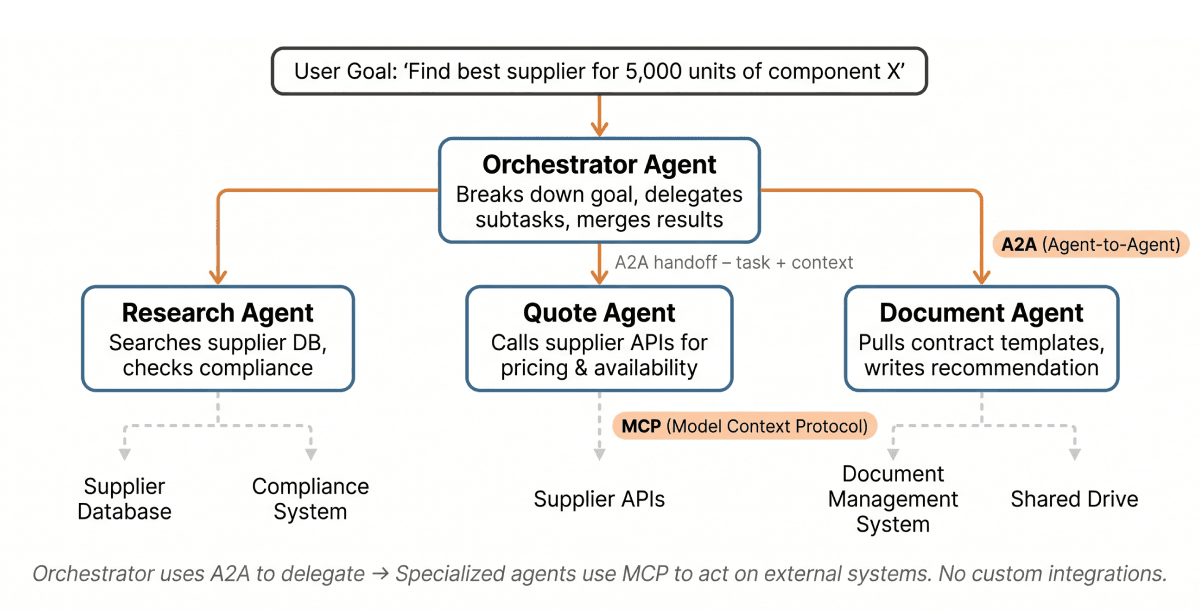
How they work together: a practical example Consider a multi-agent system handling a procurement workflow. A user submits a request: "Find the best supplier for 5,000 units of component X within our cost parameters and prepare a purchase recommendation."
The orchestrator agent receives the goal and breaks it into subtasks. It delegates supplier research to a research agent via A2A, passing along the relevant context: component specifications, cost ceiling, preferred regions. The research agent, using MCP, connects to the supplier database, pulls current pricing and availability, and queries the compliance system to check each supplier against approved vendor criteria. It returns a ranked shortlist to the orchestrator, again via A2A.
The orchestrator then hands off to a document agent, which uses MCP to pull the relevant contract templates from the document management system, populate them with the selected supplier's details, and write the completed recommendation to the shared drive.
At no point did anyone write a custom integration between the agents and the supplier database, the compliance system, or the document store. MCP handled the vertical connections. A2A handled the horizontal ones. The orchestrator coordinated the whole flow.
Where Agentic AI Is Being Deployed in the Enterprise
Agentic AI is delivering the most consistent results in domains where workflows are high-volume, well-defined, and involve interactions across multiple systems. The examples below reflect deployments where the agent takes action across systems rather than simply advising a human to do so.
Customer Operations: Klarna Klarna's AI assistant is one of the clearest documented cases of an agent executing consequential actions autonomously at scale. Launched in February 2024 in partnership with OpenAI, the assistant handles customer service conversations end to end across 35 languages and 23 markets, managing refunds, processing returns, resolving payment disputes, and updating account records without a human agent in the loop for routine cases. Within its first month, it handled 2.3 million conversations, equivalent to the workload of 700 full-time agents, while matching human agent satisfaction scores [3]. By late 2025, that figure had grown to the equivalent of 853 full-time agents, with estimated savings of $60 million [4].
The deployment also carries an important lesson for enterprise leaders. By mid-2025, Klarna acknowledged that aggressive automation had compromised service quality on complex cases, and it reintroduced human agents for situations that exceeded the agent's reliable operating range. That course correction is what good deployment governance looks like in practice. The agent handles the high-volume, well-defined tier of work. Humans handle the edge cases that require judgment and empathy. The boundary between those two tiers is the design decision that determines whether a deployment succeeds or fails.
Audit and Compliance: EY EY's Canvas platform is a strong example of genuine multi-agent orchestration in a regulated workflow. In April 2026, EY embedded a multi-agent framework into EY Canvas, built on Microsoft Azure, Microsoft Foundry, and Microsoft Fabric, with agents coordinating across audit tasks: autonomously assigning work, requesting client documentation, reconciling journal entry data, drafting review notes, and summarizing audit findings. Auditors retain judgment and sign-off at key decision points, but the agents handle the operational coordination that would otherwise consume hours of professional time. The system is now live for 130,000 EY assurance professionals across 160,000 engagements in more than 150 countries, processing 1.4 trillion lines of journal entry data annually [5]. Full end-to-end audit support is the stated goal by 2028.
The traceability and documentation requirements of regulated audit work are among the most demanding of any enterprise domain. A multi-agent system operating inside those constraints, with auditability built in from the start, makes EY Canvas one of the more instructive blueprints for agentic deployment in high-stakes environments.
HR and Finance Operations: Workday Workday's Sana platform, launched to all 11,500+ Workday customers worldwide in March 2026 following Workday's $1.1 billion acquisition of Sana Labs [6], represents one of the broadest agentic deployments across HR and finance operations to date. The Sana Self-Service Agent handles routine HR and finance tasks using over 300 pre-built skills, answering employee queries on leave balances, pay, and benefits, and acting on them directly: updating records, submitting requests, and triggering approval workflows, without requiring the employee to navigate Workday's traditional interface. The platform connects to third-party tools including Gmail, Slack, Salesforce, SharePoint, and Jira, coordinating actions across systems in a single workflow.
The platform supports A2A and MCP approaches, allowing agents to hand off tasks to each other in real time within a single workflow. More than 65% of the Fortune 500 are Workday customers [7], meaning this is agentic AI operating inside the HR and finance infrastructure of a significant portion of the world's largest organizations. Published outcome metrics from customers are limited at this stage, but the architectural foundation and deployment scale are independently verifiable.
The Gap Between Pilot and Production
Despite the examples above, the overall picture of enterprise agentic AI adoption reflects a significant gap between experimentation and production. Deloitte's 2025 Emerging Technology Trends study found that while 30% of organizations are exploring agentic options and 38% are piloting solutions, only 14% have solutions ready to deploy and 11% are actively using these systems in production [8]. Gartner warns that over 40% of agentic AI projects risk cancellation by 2027 due to escalating costs, unclear business value, and inadequate governance [9].
The gap is not primarily a technology problem. The models are capable. The use cases are proven. What stalls organizations at the pilot stage is a cluster of operational and organizational challenges that become visible only once you try to move from a controlled environment into production.
Defining what the agent is allowed to do. In a pilot, scope is implicit. In production, it has to be explicit and enforced. Organizations that move successfully to production have clear answers to questions like: which decisions can the agent make autonomously, which require human approval, and what happens when the agent encounters a situation outside its defined boundaries. Without this, agents either get constrained to the point of uselessness or take actions that create downstream problems that are difficult to attribute or reverse.
Connecting to the systems where work actually happens. A pilot can demonstrate value against a static document store or a sandboxed dataset. Production requires the agent to read from and write to live operational systems, which means navigating real access controls, data freshness requirements, and the integration complexity of enterprise software that was never designed with AI agents in mind. This is often where the gap between demo performance and real-world performance becomes visible.
Building observability before scaling autonomy. In production, you need to know what every agent did, why it did it, and what the outcome was, both for debugging and for compliance. Organizations that skip this step find themselves unable to diagnose failures, unable to satisfy audit requirements, and unable to build the internal confidence that justifies expanding agent scope. Observability is not a feature to add later; it is a prerequisite for trust.
Governing agent behavior over time. An agent that performs well at launch can degrade as the underlying data, systems, or business rules change around it. Production deployments require processes for monitoring agent output quality, updating agent behavior when requirements shift, and managing the agent's permissions as its scope evolves. This is a new kind of operational responsibility that most organizations do not yet have a function for.
None of these gaps are deal breakers, and they do not need to be solved sequentially. Many organizations run governance design, integration work, and observability tooling in parallel. The ones that reach production reliably are the ones that treat these as engineering requirements from the start rather than problems to solve after the pilot succeeds.
Architecture Considerations for Enterprise Deployment
Building agentic systems for enterprise use requires architectural decisions across several layers that do not apply to simpler LLM applications.
Tool Design and Scope The tools available to an agent define both its capability and its risk surface. Each tool should have a precisely defined schema, a clear description of what it does and does not do, and typed input and output parameters. Vague tool descriptions cause agents to misuse them or select the wrong tool for a given step. It is also important to design tools with the minimum necessary permissions: an agent that only needs to read from a database should not have write access.
Memory Architecture Long-running agentic tasks accumulate context that eventually exceeds any model's context window. The practical approaches to managing this are to summarize completed steps and compress them into the active context, to write intermediate results to an external store and retrieve only what is relevant at each step, and to use structured state objects rather than raw conversation history to represent the current state of a task. The right approach depends on the latency requirements and the nature of the task.
Human-in-the-Loop Design Not all decisions in an agentic workflow should be made autonomously. For enterprise deployments, defining explicitly which decisions require human approval is part of the architecture, not an afterthought. A procurement agent, for example, might autonomously gather quotes and check inventory, but route any purchase above a defined threshold to a human approver before executing. This kind of conditional escalation needs to be designed into the system from the start, with clear interfaces for human review and approval.
Observability and Audit Trails Enterprise procurement committees and legal teams require complete, queryable records of every agent action. Deployments that cannot produce this documentation cannot pass enterprise security review. Every step of an agent's execution loop, including what the agent decided, which tool it called, what parameters it passed, and what the tool returned, should be logged and traceable. This is both an operational requirement for debugging and a compliance requirement in regulated industries. Tools like LangSmith, Langfuse, and Arize Phoenix provide tracing infrastructure for agentic pipelines.
Failure Handling and Retry Logic Agentic systems accumulate errors across steps in a way that single-turn LLM calls do not. An incorrect action at step three of a ten-step task can produce a result at step ten that is wrong in a way that is hard to attribute to the original failure. Production agentic systems need explicit error handling at each tool call, retry logic with backoff for transient failures, and a defined behavior for what happens when a tool returns an unexpected result: whether to retry, to ask for clarification, or to abort and escalate.
Security Considerations
Because agents take actions in external systems, the consequences of a security failure are more significant. The key considerations for agentic deployments are:
Prompt injection. Malicious content embedded in data that an agent retrieves, such as a document, a web page, or a database record, can cause the agent to deviate from its intended behavior and execute unintended actions. Defenses include validating tool outputs before passing them back to the agent and maintaining strict separation between user-provided content and system instructions.
Permission scoping. Agents should operate with the minimum access required for their task. Role-based access control at the tool level limits how far a problem can propagate if an agent behaves unexpectedly.
Audit logging. Every action an agent takes should be logged and queryable. This is both an operational requirement for debugging and a compliance requirement in regulated environments.
Tool and data integrity. A compromised tool or poisoned data source can cause an agent to behave incorrectly even if the agent itself is functioning as designed. Validating the integrity of tools and data sources is part of the security surface of an agentic system.
Identity and authentication. Agents often act on behalf of users or other systems. Managing how those identities are scoped and revoked, and ensuring agents do not inherit broader credentials than their task requires, is a distinct operational responsibility.
Governance and Accountability
As agents take on more consequential tasks, governance becomes a design constraint rather than a compliance exercise. The EU AI Act, enforceable from August 2026, classifies most multi-agent orchestration in high-impact sectors as high-risk, requiring human-in-the-loop oversight, immutable audit trails, and persistent identity management throughout the agent lifecycle.
Beyond regulatory requirements, enterprises need to answer practical governance questions before scaling agentic deployments:
- •Who is accountable when an agent makes an incorrect decision?
- •How are agent permissions granted, reviewed, and revoked?
- •What is the process for updating an agent's behavior when requirements change?
- •How are agents monitored for drift in output quality over time?
The organizations seeing the most durable results from agentic AI are the ones that have treated these questions as engineering requirements from day one, building accountability structures, audit trails, and escalation paths into the agent's architecture rather than retrofitting them after deployment.
Choosing the Right Starting Point
The architectural complexity detailed above is precisely why enterprises must be highly selective when choosing their initial use cases. Getting the foundation right on a well-chosen workflow builds the governance, observability, and integration infrastructure that makes expanding to the next workflow significantly easier. The most reliable predictor of success is workflow characteristics, not industry or function. Workflows well suited for early agentic deployment share the following properties:
High volume: enough instances to justify the investment in building and governing an agent. Well-defined steps: the process can be described clearly enough to specify what the agent should do at each point.
Measurable outcomes: you can define what success looks like and track it.
Bounded risk: errors are recoverable, and the cost of a mistake is manageable.
Multi-system interaction: the workflow currently requires switching between several tools or systems, which is exactly what agents are designed to handle.
Starting with a workflow that fits these criteria, getting it right in production, and then expanding to adjacent workflows is the pattern that separates successful agentic deployments from the majority that stall in pilot.
At Rootcode, we help organizations and governments design and build production-grade AI systems, including agentic architectures. If you are exploring how agentic AI fits into your operations, get in touch with our team today.
Share this article:
Rootcode Editorial
Content Specialist
The Rootcode Editorial team writes across design, AI, and engineering -bringing the perspectives and knowledge of the Rootcode team to a wider audience.
Let’s talk about how to transform your business.



Rootcode EU
Sakala tn 7-2,
Kesklinna linnaosa,
Tallinn,
Harju maakond,
10141, Estonia

Rootcode Sri Lanka
No. 42,
Level 15,
Nawam Mawatha,
Colombo 00200,
Sri Lanka





© 2026 Rootcode. All Rights Reserved