
UX for B2B Products: Why most Enterprise Software face Usability challenges
Discover why enterprise software often struggles with usability and how B2B UX design can boost productivity, reduce errors, and improve adoption. Learn practical strategies to create intuitive, role-based, and efficient digital tools for modern businesses.
Enterprise software forms the backbone of modern business operations. Organizations rely on complex digital platforms to manage everything from supply chains and financial reporting to human resources and customer relationships. However, despite the critical nature of these tools, business-to-business (B2B) software often falls short when it comes to usability.
While consumer-facing (B2C) applications have evolved to offer seamless, intuitive experiences, enterprise software often remains cluttered, confusing, and inefficient. This difference creates significant friction in the workplace, leading to lost productivity and frustrated employees. Understanding why this usability problem exists and how to solve it is critical for organizations looking to maximize the return on their software investments.
The Root Causes of the B2B Usability Problem
The usability issues in enterprise software are not merely the result of poor aesthetic choices. They stem from structural, historical, and procedural misalignments in how B2B software is purchased and built.
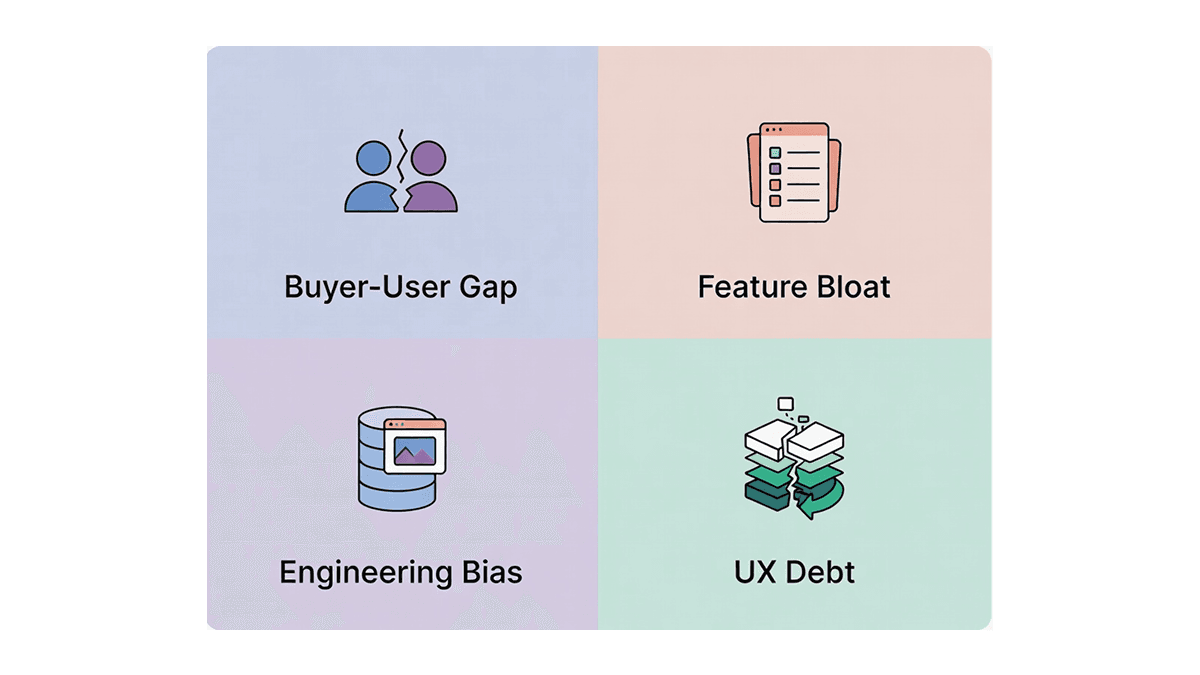
The Buyer-User Disconnect The primary driver of poor B2B usability is the structural gap between the individual who purchases the software and the individual who actually uses it on a daily basis. In consumer markets, the buyer and the user are the same person, creating an immediate feedback loop. In the enterprise sector, purchasing decisions are made by C-level executives, IT administrators, and procurement committees.
These decision-makers prioritize macro-level business goals such as return on investment (ROI), security, scalability, and compliance. Because the end-users often have little to no say in the purchasing process, software vendors optimize their products to appeal to the buyers rather than the daily operators. This results in software that looks highly capable on paper but fails to support efficient daily workflows.
Feature Bloat and the RFP Culture The procurement process for enterprise software heavily relies on Requests for Proposals (RFPs). This process encourages vendors to offer the maximum number of features to satisfy extensive compliance and capability checklists. Consequently, product teams optimize for what looks impressive in a short sales demonstration rather than what works well in practice.
This dynamic leads to "feature bloat," where core functionalities are buried under layers of secondary options. Studies show that nearly 45% of software features are rarely or never used, yet they continue to consume interface space and development resources, adding unnecessary complexity for the user [1].
Engineering Over Design In early stages, enterprise software was built by engineering teams focused entirely on technical robustness, database integrity, and process support. The user interface was treated as a secondary concern which is a functional layer exposed over raw database schemas. The dominant design philosophy was to present as much data as possible on a single screen to ensure full visibility, which unknowingly caused severe cognitive strain. Because employees lacked alternatives and were required to use employer-provided tools, vendors faced no market pressure to prioritize user-centered design.
Legacy Systems and UX Debt Many enterprises rely on systems built decades ago. Attempting to modernize these systems is highly risky, as minor interface changes can disrupt critical backend processes or compliance protocols. When teams prioritize rapid feature releases over sustainable design, they accumulate UX debt. UX debt refers to design inconsistencies, fragmented user journeys, and patched workflows that build up over time. As this debt compounds, the software becomes increasingly disjointed and difficult to navigate.
The Business Impact of Poor Enterprise UX
The economic impact of bad UX rarely appears as a direct line item on a balance sheet, but its cost shows up everywhere: in lost productivity, bloated support queues, failed adoption, and the quiet erosion of employee efficiency over time.
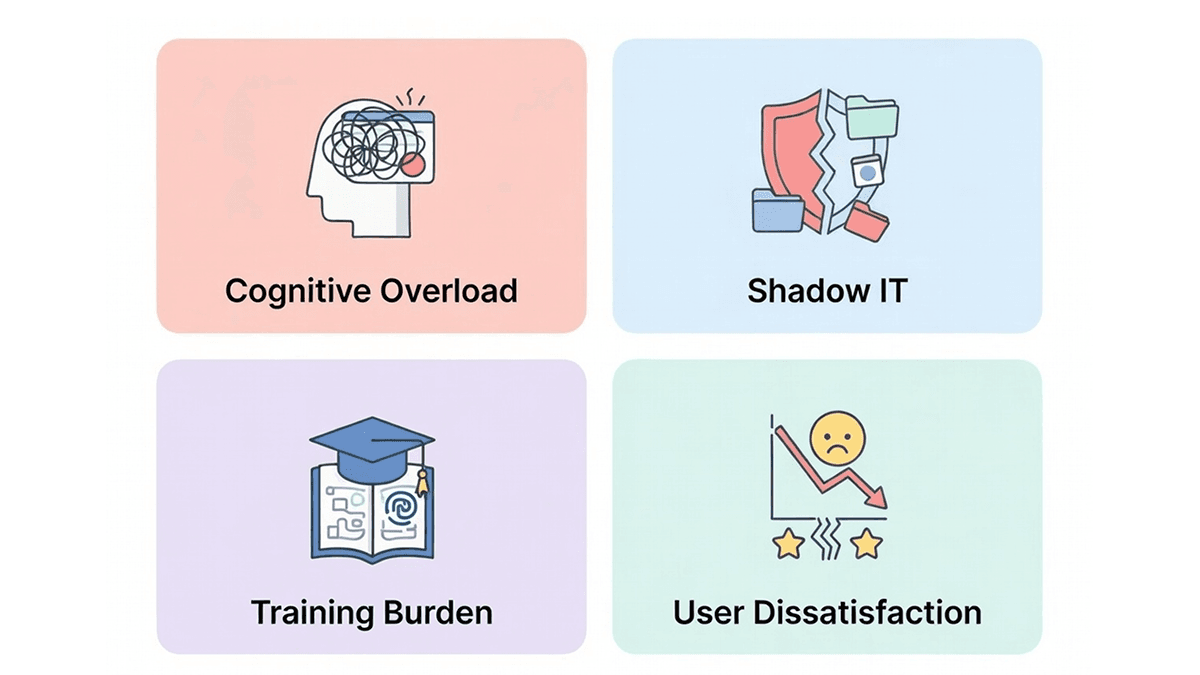
Cognitive Strain and High Error Rates Enterprise platforms often present dense screens packed with data, controls, and competing visual signals. Users must scan crowded layouts and retain multiple details in their working memory just to complete basic actions. This cognitive overload slows down task execution and drastically increases the likelihood of user error. In high-stakes environments, such as finance, the consequences of a poor interface can be catastrophic. For example, a poorly designed, non-obvious user interface at Citigroup led employees to accidentally transfer $900 million instead of the intended $7.8 million, resulting in a massive unrecoverable financial loss [1].
Low Adoption and the Rise of Shadow IT When official enterprise tools are clunky and counterintuitive, employees naturally seek out unauthorized workarounds. This phenomenon is known as "Shadow IT". Users revert to familiar tools like spreadsheets or consumer-grade applications to get their work done. This refusal to adopt the official software creates severe data silos, compliance risks, and security vulnerabilities, ultimately defeating the purpose of the enterprise software investment.
The Training Fallacy A common organizational response to poor software usability is to invest heavily in employee training. However, relying on instruction manuals and training sessions to overcome a bad interface is both expensive and ineffective. If a digital product requires hours of training for a user to perform basic, routine tasks, it represents a failure of design, not a deficiency in the user.
Measurable Dissatisfaction The frustration with B2B software is measurable. According to benchmark data, the average Net Promoter Score (NPS) for business software is -5%, with some major tools scoring in deep negative territory. This indicates that the majority of enterprise users are active detractors of the tools they are mandated to use for work. Furthermore, 88% of users state they are less likely to return to a platform after a poor user experience, highlighting how quickly poorly designed software erodes user trust [2].
Key Strategies for Designing Effective B2B UX
Solving the enterprise usability crisis requires understanding that B2B UX design needs a different approach than B2C design. B2B software must prioritize efficiency, functionality, and the facilitation of complex professional workflows.
Prioritize Functional Workflows Over Aesthetics In enterprise software, the guiding principle must be "function over form". While consumer apps use visually captivating designs to hold attention, B2B software must facilitate rapid, accurate task completion. Designers must start by mapping real-world workflows and minimizing the steps required to achieve a goal. Efficiency is the primary metric of satisfaction for a professional user. Reducing the number of clicks, providing keyboard shortcuts, and automating repetitive data entry directly translates to higher productivity.
Implement Role-Based Interfaces A single B2B application is used by various personas, including administrators, executives, and frontline operators. A one-size-fits-all interface inevitably overwhelms casual users with advanced settings while restricting power users. Effective B2B design segments these audiences by utilizing role-based views. Frontline workers should see simplified, task-driven interfaces, executives should see high-level performance dashboards, and administrators should have access to deep configuration layers.
Manage Data Density with Progressive Disclosure Because enterprise applications inherently deal with large datasets, removing complexity entirely is impossible. Instead, designers must manage how and when users experience that complexity. Utilizing progressive disclosure ensures that users are only shown the most essential information required for their immediate task. Advanced details and complex settings should remain hidden until specifically requested by the user. Breaking complex forms into smaller, logical groups reduces cognitive load and makes dense information manageable.
Utilize Scalable Design Systems To prevent the accumulation of UX debt and ensure consistency across massive applications, enterprise teams must establish strong design systems. A design system is a comprehensive library of reusable components, typography rules, and layout guidelines. This ensures that an application behaves predictably across all modules. Implementing a design system accelerates the development process and dramatically reduces the engineering rework associated with fragmented interface designs. Rootcode design engineers build enterprise-grade design systems, allowing businesses to scale their software predictably while maintaining a cohesive, professional user experience across all digital touchpoints.
Meet Consumer-Grade Expectations The modern workforce expects enterprise tools to demonstrate the same intuitiveness and responsiveness found in consumer applications. Employees evaluate workplace technology based on its speed, mobile accessibility, and clarity. Meeting these consumer-grade expectations is now a requirement for driving software adoption and maintaining high employee morale.
The ROI of Investing in Enterprise UX
Investing in user experience is often viewed as an added expense, but the business case for UX proves it is a powerful driver of profitability.
The $1 to $100 Rule The industry standard demonstrates that every $1 invested in UX design yields a return of $100 - an ROI of 9,900%. This massive return is generated through multiple operational efficiencies. A well-designed user interface can increase conversion rates and task success by up to 400% [3]. Furthermore, fixing usability issues during the design phase is up to 100 times cheaper than attempting to restructure code after a product has been released.
Tangible Business Outcomes High-performing organizations that prioritize UX see immediate reductions in training overhead, lower customer support volumes, and higher employee productivity. For example, when SAP recognized that its powerful software was too complex for users, they introduced SAP Fiori which is a design system that replaced complex menus with role-based, intuitive apps. This resulted in faster task completion and drastically lowered training costs. Similarly, when Salesforce overhauled its clunky interface with the Salesforce Lightning update, studies showed a 341% ROI due to massive spikes in sales team productivity and user adoption [4].
Conclusion
The usability problem in enterprise software is a systemic issue born from decades of prioritizing technical checklists over human-centered design. However, as the digital landscape matures, organizations can no longer afford the hidden taxes of poor UX: high error rates, slow task execution, and the proliferation of shadow IT.
To build successful B2B products, companies must bridge the gap between the buyer and the end-user. By focusing on role-based personalization, progressive disclosure, and efficient workflows, enterprise software can transition from being a mandatory organizational burden into a strategic asset that drives efficiency, high adoption, and measurable business growth. Ready to modernize your enterprise software? At Rootcode, we specialize in transforming complex B2B platforms into intuitive, high-performing digital products. We bridge the gap between powerful functionality and a seamless user experience. Stop letting bad design drain your operational efficiency. Talk with us today to discover how we can elevate your enterprise software and build a solution tailored perfectly to your business needs.
Share this article:
Let’s talk about how to transform your business.



Rootcode EU
Sakala tn 7-2,
Kesklinna linnaosa,
Tallinn,
Harju maakond,
10141, Estonia

Rootcode Sri Lanka
No. 42,
Level 15,
Nawam Mawatha,
Colombo 00200,
Sri Lanka






© 2026 Rootcode. All Rights Reserved