Single-Tenant vs Multi-Tenant Architectures: A Practical Guide
Learn the differences between single-tenant and multi-tenant architectures, including shared schema, separate schema, and database-per-tenant models.
There is no single “correct” system architecture. Developers use different architectural patterns based on their needs. Some teams prefer monolithic systems, while others choose microservices or event-driven architectures, depending on business requirements, scalability needs, and budget constraints. Each approach has its own strengths, and the right choice always depends on the context.
However, beyond how systems are structured, there is another important concept that focuses on how applications serve multiple users efficiently. That concept is tenancy, and in today’s article, we will take a deep dive into its different types and the advantages.
What Does Tenancy Mean?
Tenancy refers to the way a software system manages and separates different customers, organizations, or groups of users while using the same application or infrastructure. In software architecture, a tenant usually represents a single customer, company, institution, or independent group of users that uses the system.
What is Single Tenancy?
Single tenancy is one of the two primary tenancy models used in software systems. In a single-tenant architecture, each tenant gets its own dedicated environment. This typically includes dedicated application resources, a dedicated database, and in some cases dedicated servers or cloud infrastructure. Because of this, the data and infrastructure of one tenant are completely isolated from others. Also single tenancy is considered the opposite of multi-tenancy.
For example, assume a company provides a project management SaaS application to multiple organizations. In a single-tenant setup, each organization receives its own dedicated backend application and database, as shown below:
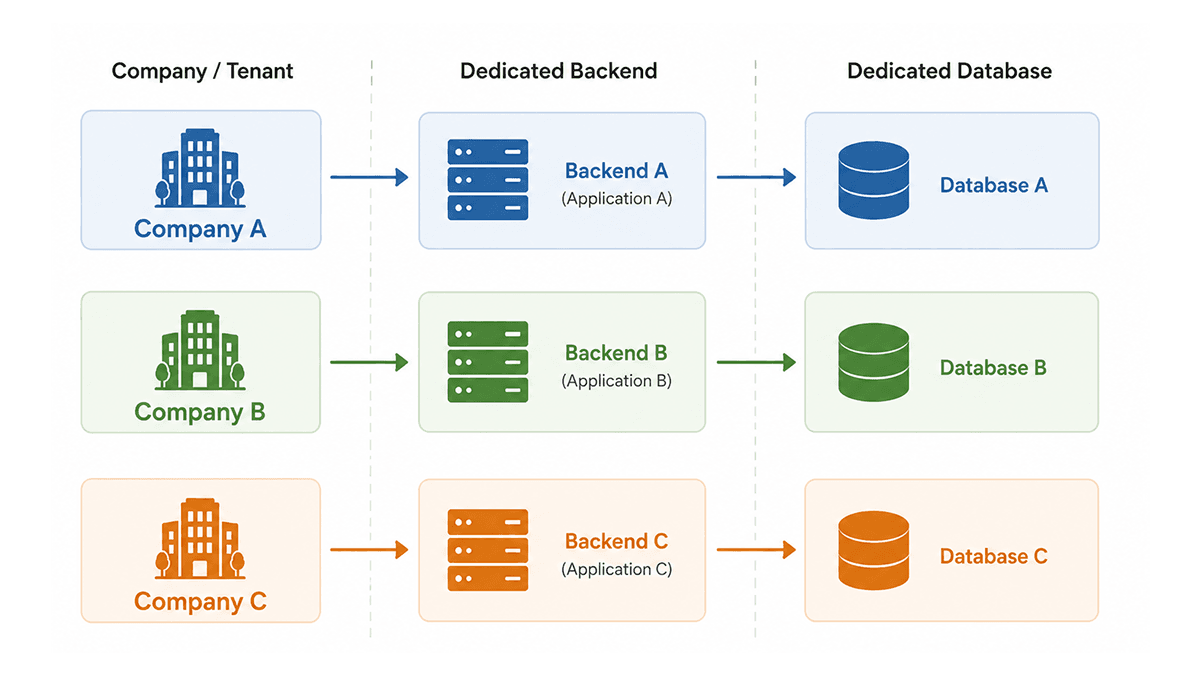
Each company runs independently with its own dedicated resources. Even if one company’s system crashes, becomes overloaded, or requires customization, it usually does not directly affect the others. This is why single tenancy is highly focused on strong data isolation, security, customization, and independence between tenants.
Single tenancy is not exactly an architectural pattern like monolithic or microservices. Instead, it is more of a deployment and isolation model that defines how tenants share or do not share resources.
This model was very common in traditional enterprise applications and early cloud systems. Large organizations such as banks, healthcare systems, and government institutions often prefer single tenant systems because they require stronger security, compliance, and control over their infrastructure and data.
What is Multi-Tenancy?
As mentioned earlier multi-tenancy is not a pure architectural pattern like monolithic, microservices, or client-server. Instead, it is a design approach that defines how a system serves multiple customers (tenants) using shared or isolated resources.
In a multi-tenant system, a single application can serve multiple tenants, where each tenant represents a separate customer, organization, or group of users. Even though the application is shared, each tenant’s data and experience are logically isolated
So, rather than defining how the system is structured, multi-tenancy defines:
- •how data is separated
- •how resources are shared
- •how tenants are managed and isolated
Types of Multi tenancy
Shared Database, Shared Schema
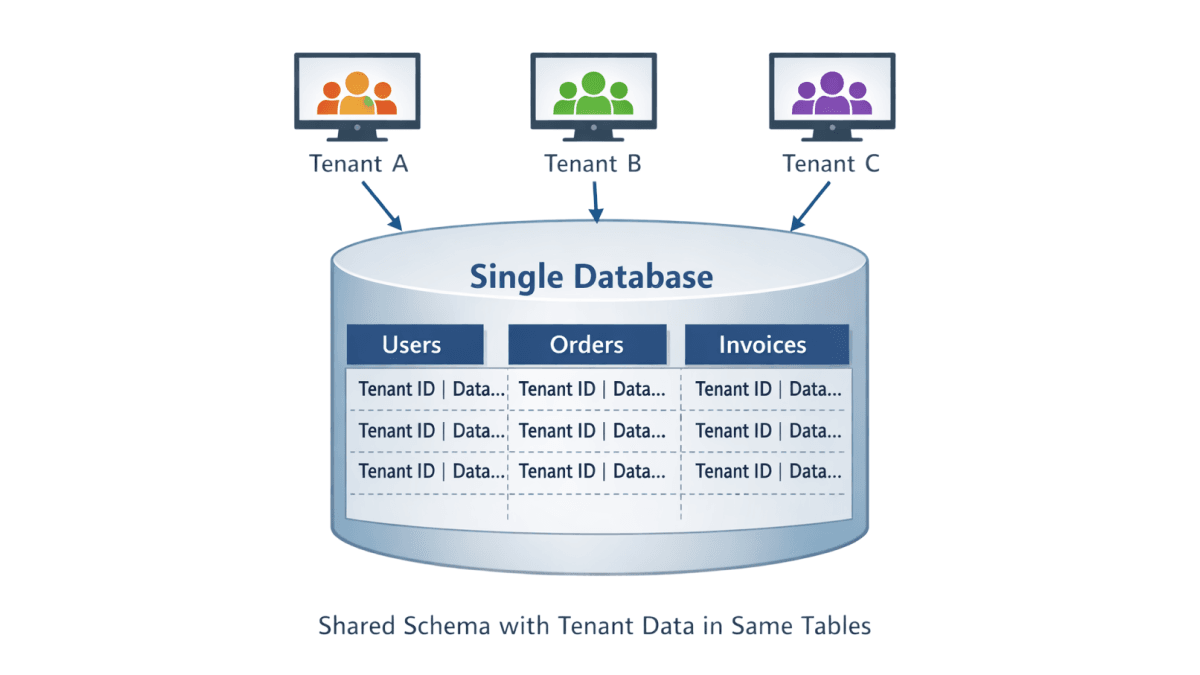
In this model, all tenants share the same backend, same database, and the same database schema. Tenant data is usually separated logically using identifiers such as tenant_id. This is the most cost-efficient and scalable multi-tenant model because all resources are shared among users. Many beginner SaaS applications start with a shared database and shared schema approach, where tenant data is separated logically using a tenant identifier. However, it requires careful security and query handling to prevent tenants from accessing each other’s data. This model is commonly used in very large consumer applications where millions of users use the same system simultaneously.
Advantages
- •Very low cost
- •All tenants share the same database and backend, so infrastructure cost is minimal
- •Highly scalable
- •Easy to support millions of users because everything runs on a single shared system
Disadvantages
- •Weak isolation risk
- •A bug in queries or access control can accidentally expose one tenant’s data to another
- •Performance interference (Highest risk of noisy neighbor issue)
- •Heavy usage by one user or tenant can slow down the entire system
Example: Consumer social platforms (Slack)
Even though platforms like Instagram and Facebook can theoretically be considered under this category, in practice their systems are far more complex due to the massive number of users and requests they handle daily. Instead of relying on a single shared backend and database alone, they typically use distributed architectures with separated services, orchestration platforms, caching layers, database sharding, load balancing, and microservices to achieve scalability, reliability, and performance.
Shared Database, Separate Schemas
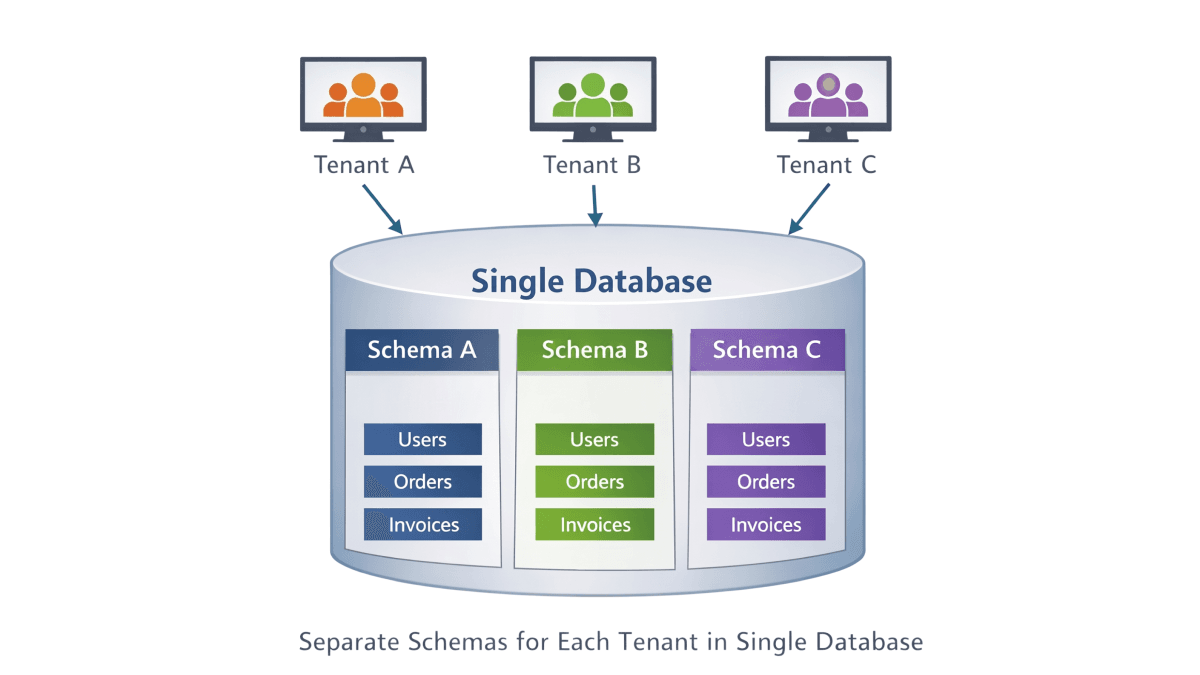
In this pattern it is added some more separation than the previous one.Here tenants still share the same database server, but each tenant has its own separate schema inside the database. This provides better isolation compared to a shared schema because tables and structures are separated per tenant. It also allows some tenant-specific customization without requiring completely separate databases. Resource usage is still lower than full single-tenancy because the database infrastructure is shared. This approach is often used in SaaS platforms that need moderate tenant isolation while keeping operational costs manageable.
Advantages
- •Better isolation than shared schema
- •Each tenant has its own schema, so data and structure are more separated.
- •Moderate cost with flexibility
- •Still cheaper than full single-tenancy while allowing some customization per tenant.
Disadvantages
- •More complex management
- •Handling multiple schemas increases backend and migration complexity
- •Database still shared
- •A database-level failure or overload still affects all tenants
- •Performance interference (Moderate risk of noisy neighbor issue)
- •Heavy usage by one user or tenant can slow down the entire system
Example: ERP platforms (finance, HR, inventory systems)
Database per Tenant
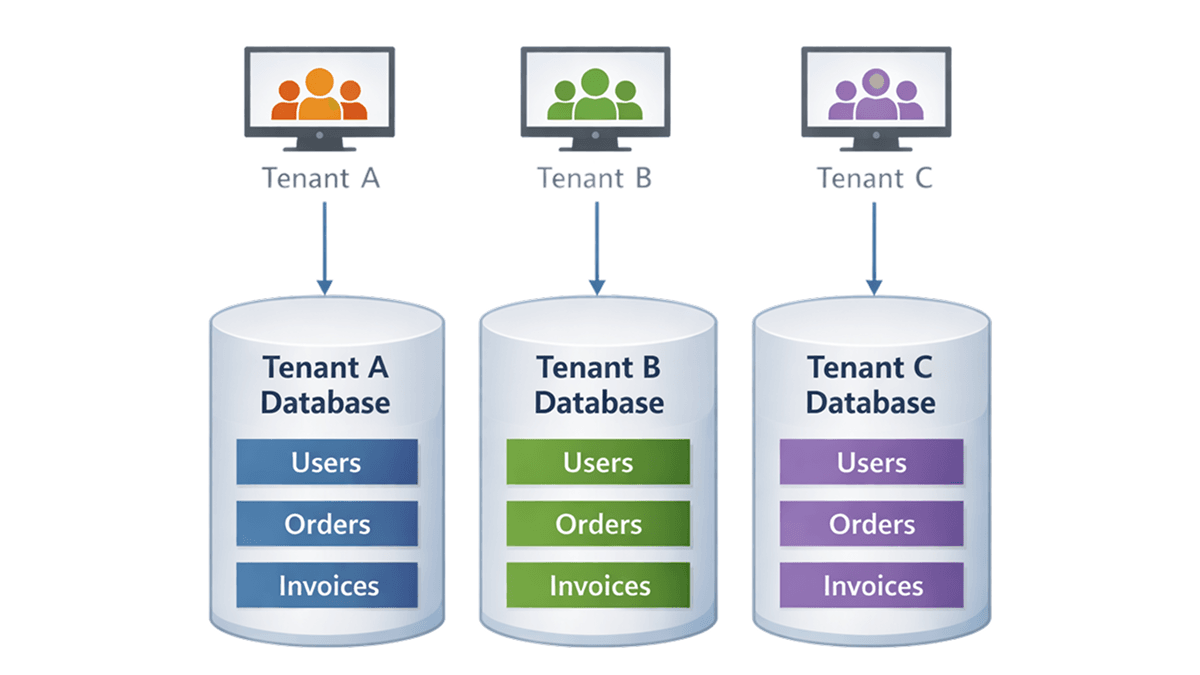
This has the highest separation among these three models. Here each tenant gets a separate database, while the application infrastructure may still be shared. This provides strong data isolation, improved security, and better tenant-level customization compared to shared-database approaches. Tenant databases can also be scaled, managed, and backed up independently without directly affecting other tenants. Problems in one tenant’s system usually do not affect others because resources are dedicated. This architecture is commonly used for enterprise customers with strict compliance, privacy, or performance requirements. However, infrastructure and maintenance costs become much higher because each tenant requires separate deployments and resources.
Advantages
- •Strong isolation and security
- •Each tenant is completely independent, reducing risk of data leakage
- •Independent scaling and customization
- •Each tenant can be scaled or customized without affecting others
Disadvantages
- •High cost
- •Every tenant needs its own infrastructure, which becomes expensive at scale
- •Hard maintenance and deployment
- •Updates, fixes, and monitoring must be done separately for each tenant system
Example: SAP (enterprise/private cloud deployments where each customer may have a dedicated database or full system instance)
Key Decision Factors: Single-Tenant vs Multi-Tenant
1. Customization and Flexibility If each customer needs highly unique features, workflows, or database structures, single-tenancy is usually more suitable because each tenant has a separate environment. Multi-tenancy works best when the application provides a standardized experience for all users, with minimal per-customer variation.
2. Compliance and Data Regulations Industries like finance, healthcare, and government often require strict data isolation and control due to legal or compliance rules. In such cases, single-tenancy is preferred because it ensures strong physical or infrastructure-level separation of data between tenants.
3. Budget and Scale Requirements Multi-tenancy is ideal for startups and large-scale SaaS products because it significantly reduces infrastructure cost and supports rapid scaling. Single-tenancy, while more secure and isolated, becomes expensive as the number of customers increases because each tenant requires dedicated resources.
Conclusion
We explored a fundamental but very important concept in software architecture: tenancy models in system design. We discussed how single tenancy and multi-tenancy differ in terms of data isolation, infrastructure sharing, and scalability. You should now have a clear understanding that these concepts are not just theoretical and they directly impact how real world systems like social media platforms, SaaS products, and enterprise applications are designed and scaled.
The key takeaway is that there is no “best” model universally. Instead, the right choice depends on the system’s goals, expected user scale, cost constraints, and security requirements. Understanding this trade-off is essential for designing modern, production-ready software systems.
Share this article:
Dewmin Deniyegedara
Intern Software Engineer
Dewmin Deniyegedara is a third-year undergraduate at the University of Moratuwa specializing in Software Engineering. His primary interests lie in backend architecture, particularly using .NET and Spring Boot, as well as cloud-native technologies and distributed systems. In addition to software engineering, he has a keen interest in cybersecurity and modern application security practices.
Let’s talk about how to transform your business.


Rootcode EU
Sakala tn 7-2,
Kesklinna linnaosa,
Tallinn,
Harju maakond,
10141, Estonia

Rootcode Sri Lanka
No. 42,
Level 15,
Nawam Mawatha,
Colombo 00200,
Sri Lanka


© 2026 Rootcode. All Rights Reserved