
How to Choose a UI/UX Design Agency: 12 Questions Every Founder Should Ask
Not sure how to evaluate a UI/UX design agency? Here are 12 practical questions to ask before you commit, covering process, research, timelines, and what good collaboration actually looks like.
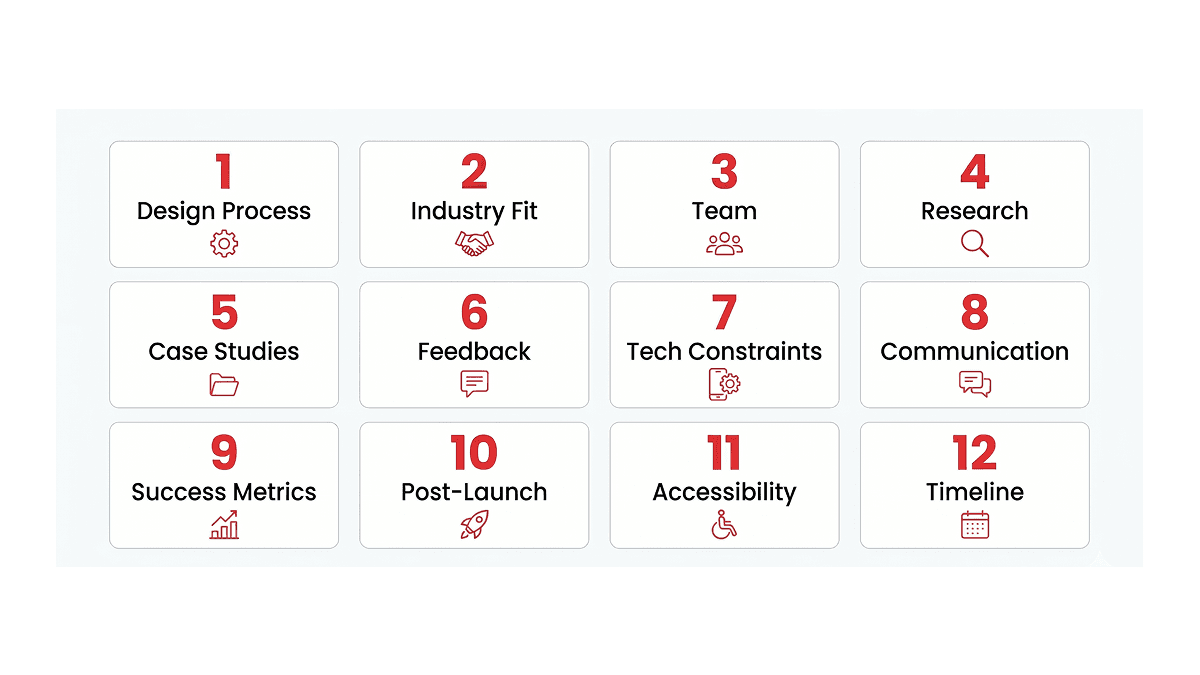
Hiring a UI/UX design agency is one of the more significant decisions you will make for your product. The right agency can help you build an experience that is clear, intuitive, and genuinely useful for your users. Getting the fit wrong, on the other hand, can lead to delays, rework, and a product that misses the mark.
The challenge is that most agencies present well during the initial conversation. Portfolios look polished, proposals sound thorough, and references check out. The quality of the working relationship often only becomes visible once a project is underway.
This guide gives you 12 practical questions to ask any UI/UX design agency before you commit. Each one is meant to help you understand how an agency actually works, so you can make a more informed decision.
Why Getting This Right Matters
Before getting into the questions, it helps to understand what is really at stake. Research consistently shows that poor user experience is one of the leading reasons digital products struggle to gain traction. When users find a product confusing or frustrating, they tend to disengage quietly rather than raise concerns. By the time that pattern shows up in the data, it can be expensive to fix.
A UI/UX agency shapes far more than how your product looks. They influence how users move through it, how quickly they find value, and how likely they are to return. That makes the selection process a strategic conversation, not just a creative one.
With that framing in mind, here are the questions worth asking.
The 12 Questions to Ask
1. Can you walk me through your design process, from start to finish?
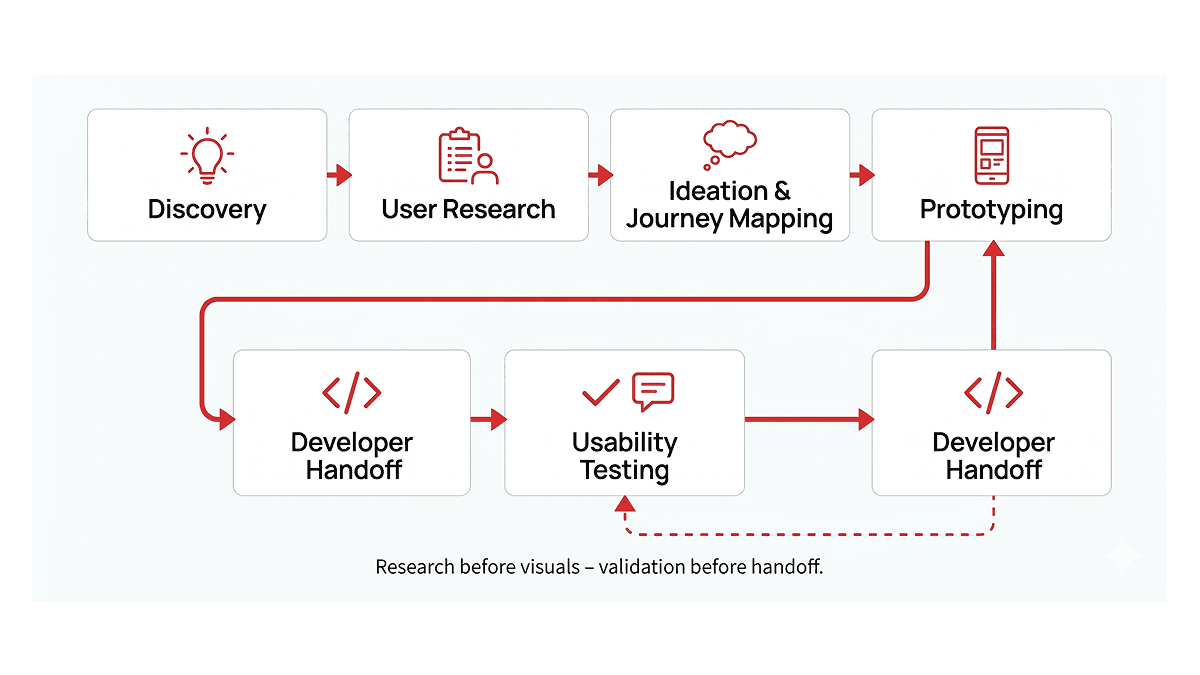
This question helps you understand how the agency approaches a project at a structural level. A well-defined process typically includes a discovery phase, user research, ideation, prototyping, testing, and a developer handoff. Being able to explain why each step exists and how it feeds into the next is a good indicator of how methodically they work.
What to listen for: Look for an agency that begins with understanding the user before moving into visual design. A process that starts with research and validation tends to produce more reliable outcomes than one that moves straight into execution.
An example of a clear answer: "We start with a discovery phase to understand your users and your business goals. From there we move into research and journey mapping before we touch any visual design. Testing happens alongside design, and we do not move to handoff until the key flows have been validated with users."
2. Have you worked on products in my industry or at a similar stage of growth?
Industry familiarity can speed up a project. An agency with experience in fintech, SaaS, or healthcare will likely already understand the expectations, patterns, and sensitivities common in those spaces. That prior knowledge can reduce the time spent getting everyone aligned on context.
That said, a solid agency with strong research skills can do good work in a new industry, provided they have a clear approach for getting up to speed.
Ask for examples of past work that are similar to your product in scope, industry, or stage. Ask what they found challenging and how they navigated it.
3. Who will be working on my project?
This is a practical question worth asking early. Project teams vary in how they are staffed, and it is useful to know in advance who will be doing the hands-on design work, how experienced they are, and how much of their time will be dedicated to your project.
Ask for the names and backgrounds of the team members who will be assigned to your account. Ask whether they will be working on your project exclusively or across several at once. Also ask what the process is if a key person becomes unavailable during the engagement.
Good agencies are transparent about team composition and can give you a clear picture of who you will be working with day to day.
4. How do you approach user research?
User research is what grounds design decisions in real behavior rather than assumptions. Before design work begins, a good agency will want to develop a clear picture of your users: who they are, what they are trying to accomplish, where they run into friction, and what they already expect from products like yours.
Ask about the specific methods they use:
- •User interviews
- •Usability testing
- •Competitive analysis
- •Survey-based research
- •Jobs-to-be-done frameworks
Not every method is appropriate for every project. What matters is whether the agency can tell you which approach fits your situation and explain the reasoning behind that recommendation.
Example: For a B2B SaaS product, a well-suited approach might include interviews with your target buyers and a review of any existing usage data, before a single screen is designed.
5. Can I see case studies alongside portfolio examples?
Portfolio work shows what an agency produces visually. Case studies show how they think and solve problems. Both are worth reviewing, but the reasoning behind design decisions often tells you more than the final screens do. An agency that can walk you through their thinking on a past project gives you a much clearer signal of what working with them will be like than a gallery of finished screens ever can.
Ask for case studies that walk through the full arc of a project: the problem they were brought in to solve, the research that informed their approach, the decisions they made and why, and what happened after launch. If they cannot explain the why behind their choices, the work is likely to be surface-level, regardless of how polished it looks.
A useful benchmark: some agencies showcase highly aesthetic, Dribbble-style visuals with little to no context about the user problem, the constraints, or the outcome. That kind of presentation is worth noting. Beautiful work without explanation does not tell you whether the design actually solved anything.
Look specifically for:
- •Evidence of user testing and how it shaped the final design
- •Instances where early directions were revised based on feedback
- •Any metrics or outcomes that show the design had a positive impact
6. How do you handle feedback and revisions?
Understanding the feedback and revision process upfront helps prevent friction later in the project. There are two things worth clarifying: how the agency collects and incorporates your input, and how they handle situations where perspectives differ.
A collaborative agency will engage openly with your feedback, explain their design rationale, and work through disagreements constructively. Knowing how they approach that dynamic before the project starts makes for a smoother working relationship.
Ask:
- •How many rounds of revisions are included in the scope?
- •How do you handle feedback that conflicts with your design recommendations?
- •What is the process if both sides cannot agree on a direction?
7. How do you ensure designs can be built within your tech constraints?
Design and development need to stay aligned throughout a project. A common source of delays is receiving designs that are difficult or costly to implement as intended, often because technical constraints were not considered early enough.
A good agency will ask about your tech stack and factor those constraints into their design decisions. They will also provide handoff documentation that is detailed enough for developers to work from without ambiguity.
Ask how they handle developer handoff:
- •Do they deliver annotated specs through tools like Figma?
- •Have they worked alongside development teams before?
- •Have they ever needed to revise designs based on technical feedback, and how did they handle it?
Their answer gives you a sense of how well they integrate design with the realities of building a product.
8. What does your communication process look like?
Clear, consistent communication is one of the things that makes a design engagement feel manageable. Before starting, it is worth understanding how the agency will keep you informed and how accessible they are when questions come up.
Ask specifically:
- •How often will we have check-ins or progress reviews?
- •Who will be my main point of contact?
- •What tools do you use to share work and collect feedback?
- •What is your typical response time for questions?
Knowing the answers to these questions early helps set realistic expectations for both sides.
9. How do you define and measure success for a project like this?
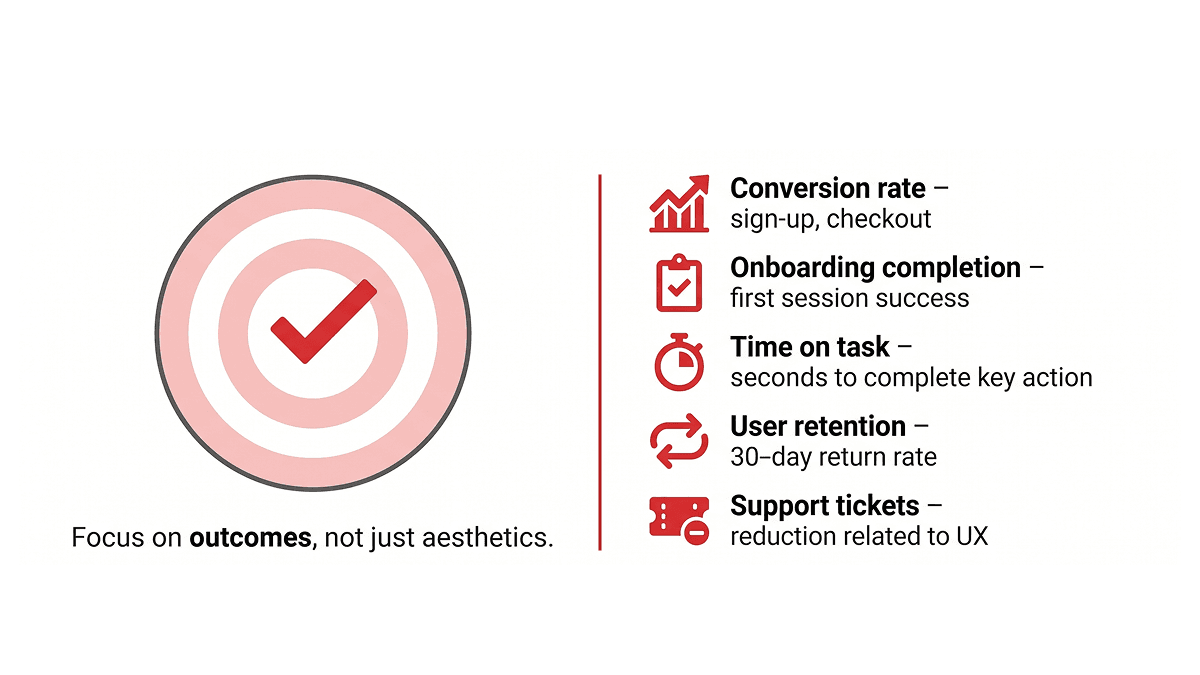
Design work is most valuable when it connects to outcomes that matter to your business, and how an agency answers this question reveals a great deal about how they think about their own work. An agency that is genuinely invested in results will want to establish what success looks like before the project begins, not after it ends.
A strong answer will go beyond aesthetics and tie design decisions to measurable outcomes. Depending on the type of project, those might include:
- •Conversion rates on key flows such as sign-up or checkout
- •Onboarding completion rates and time-to-activation
- •Task completion rates from usability testing
- •User retention over a defined period
- •Reduction in support queries related to navigation or confusion
What matters as much as the metrics themselves is whether the agency has a plan for how those outcomes will be tracked. Ask what tools or mechanisms they recommend for measurement. A well-equipped agency might suggest setting up session recording tools like Hotjar or FullStory to observe real user behavior, using analytics platforms like Mixpanel or Amplitude to track funnel drop-off, or running moderated usability tests at key milestones to catch friction before launch. Even without an existing analytics setup, a good agency will help you identify what to instrument and how, rather than leaving measurement as something to figure out later.
Example: An agency working on a SaaS onboarding redesign might propose tracking the percentage of users who complete account setup within their first session, using a combination of product analytics and in-app event tracking. That gives both sides a concrete benchmark and a shared definition of progress.
If an agency cannot articulate how they will know whether their work succeeded, that is worth paying attention to. It does not necessarily disqualify them, but it is a prompt to ask how they have handled that question on past projects and what they would recommend in your specific context. The goal is a shared framework for evaluating the work, not just a handoff of deliverables.
10. What support do you offer after the project is delivered?
Products continue to evolve after launch based on how users actually interact with them. It is worth understanding what kind of ongoing support or follow-up an agency offers once the initial engagement is complete.
Ask whether the agency provides:
- •A handoff session with your development team
- •A post-launch review once the product is live
- •Ongoing design support on a retainer or as-needed basis
- •Help interpreting post-launch user behavior data
Even if ongoing support is not something you plan to use immediately, the answer gives you a sense of how the agency thinks about the relationship beyond the initial delivery.
11. How do you handle accessibility in your design work?
Digital accessibility has become increasingly important, both as a legal consideration in many markets and as a general standard for inclusive, well-crafted products. Beyond compliance, accessibility is also a strong indicator of overall design quality. An interface that is clear, navigable, and usable for people with varying abilities reflects the same principles that make a product easier to use for everyone: sufficient contrast, logical structure, readable typography, and keyboard navigability.
Ask whether the agency designs to WCAG (Web Content Accessibility Guidelines) standards and whether accessibility is considered throughout the design process or reviewed only at the end. Ask if they can share an example of how accessibility shaped a specific design decision in a past project.
An agency that treats accessibility as integral to good design, rather than a final checklist, will typically produce work that holds up better across a wider range of users, devices, and contexts.
12. What does a typical project timeline look like for a project like mine?
Understanding how an agency structures time is one of the more practical things to clarify before signing. Timelines vary depending on the scope of work, the number of stakeholders involved, and how research and testing are integrated into the process. Asking this question early helps you gauge whether their pace is compatible with yours.
A well-considered answer will typically walk you through the major phases and give you a realistic sense of how long each one takes. It will also account for feedback cycles and any dependencies on your team, rather than presenting an overly optimistic end-to-end estimate.
Ask:
- •What are the key milestones in a project like this?
- •How much input will be needed from our side, and at what points?
- •What factors tend to extend timelines, and how do you handle them?
The goal is not to hold the agency to an exact date, but to understand how they think about planning and whether they communicate proactively when timelines shift.
Things to Pay Attention to During the Evaluation
As you move through the process, a few patterns are worth keeping in mind:
- •Whether discovery is part of their process. Agencies that include a discovery or research phase at the start tend to surface important context before design decisions are made, which often saves time later.
- •How they explain their design decisions. Being able to connect specific choices back to user needs or research findings is a sign of a thoughtful, intentional process.
- •Who is involved throughout the project. It is reasonable to ask whether the people you meet during the proposal stage are the same ones who will do the actual work.
- •How they talk about your users. Agencies that ask thoughtful questions about your users early in the conversation are usually ones that center user needs in their process.
- •How they respond to feedback. An agency that shares its reasoning and engages constructively with your input tends to make for a more productive working relationship.
What a Good Working Relationship Looks Like
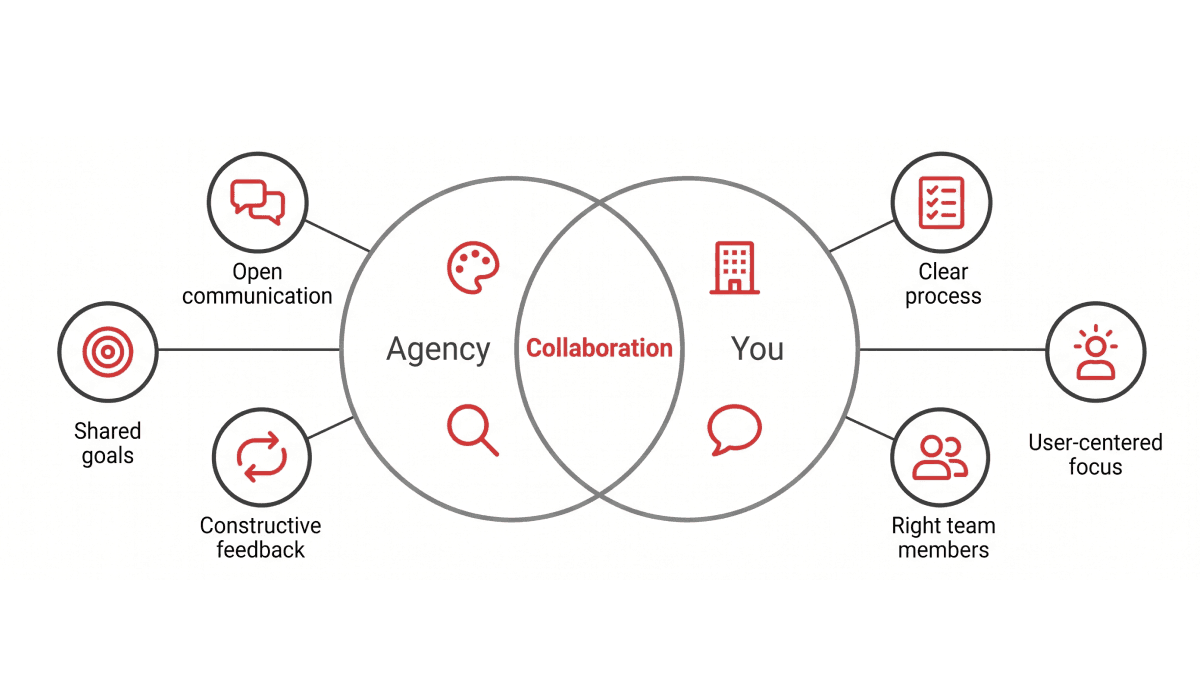
A productive design partnership is one where both sides communicate openly, share a clear understanding of goals, and approach decisions collaboratively. The agency brings design expertise and user insight. You bring product knowledge, business context, and feedback. Together, those inputs lead to better outcomes than either side could reach alone.
Notion is often used as an example of considered product design. What makes it noteworthy is how deliberately it handles complexity. The interface gives experienced users a great deal of flexibility while remaining approachable for people who are just getting started. That kind of balance comes from sustained, research-informed design decisions made over time. It is a useful example of what intentional, user-centered design can look like in practice.
Before You Start Reaching Out
Before you begin conversations with agencies, it helps to have a few things clear on your end:
- •What specific problem are you trying to solve with design?
- •Do you need a full product design, a redesign of something existing, a design system, or something else entirely?
- •What is your realistic timeline and budget?
- •Who on your team will be the primary point of contact?
Coming to the first conversation with answers to these questions makes it easier to have a focused, productive discussion and helps agencies give you a more accurate read on whether they are a good fit.
Final Thoughts
Choosing a UI/UX design agency is ultimately about finding a team whose process, communication style, and values align with how you work and what you are trying to build. The 12 questions in this guide are a starting point for those conversations. The answers will help you understand not just whether an agency is capable, but whether working with them will be a good experience for your team and your product.
Rootcode Studio offers end-to-end UI/UX design, UX audits, design sprints, and design systems for startups and growth-stage companies. If you are evaluating design partners, we are happy to walk you through our process and answer any of the questions above.
Share this article:
Rootcode Editorial
Content Specialist
The Rootcode Editorial team writes across design, AI, and engineering -bringing the perspectives and knowledge of the Rootcode team to a wider audience.
Let’s talk about how to transform your business.



Rootcode EU
Sakala tn 7-2,
Kesklinna linnaosa,
Tallinn,
Harju maakond,
10141, Estonia

Rootcode Sri Lanka
No. 42,
Level 15,
Nawam Mawatha,
Colombo 00200,
Sri Lanka






© 2026 Rootcode. All Rights Reserved