
What is a UX Audit and Why Every Growing Business Needs One
Discover why a UX audit is essential for growing businesses. Learn how identifying usability issues, reducing UX debt, and optimizing user flows can boost conversions, lower costs, and enhance customer satisfaction.

As digital products scale to accommodate larger user bases and additional features, their interfaces often become complex and fragmented. This complexity can lead to decreased user engagement, lower conversion rates, and higher customer support costs. When business metrics plateau despite steady website traffic and marketing efforts, the underlying issue is frequently the user experience (UX).
To identify and resolve these hidden usability barriers, whether before a product goes live or after it has already launched, organizations rely on a UX audit. At the design level, audits serve two primary purposes: catching critical flaws before they reach users, and refining existing products where issues have already begun to surface. This article explains what a UX audit entails, how it functions as a critical business tool, and why growing companies must integrate it into their product development lifecycle.
Understanding the UX Audit
A UX audit is a systematic, data-driven evaluation of a digital product's user interface and overall experience. It functions as a quality assurance process that determines how easily users can interact with a website or application to achieve their goals.
Unlike a standard design review, which typically focuses on visual aesthetics, user flows and interactions at a surface level, a UX audit goes deeper. It relies on empirical data, user behavior analysis, and established usability principles to identify structural flaws that a routine review would miss. The objective is to uncover friction points that hinder task completion and provide a prioritized, actionable roadmap for optimization.
A comprehensive UX audit evaluates several core components:
- •Usability and Task Flow: How efficiently users can complete primary actions, such as checking out or signing up.
- •Information Architecture: How content and features are structured and labeled, ensuring users can navigate without confusion.
- •Accessibility: Whether the product complies with standards like the Web Content Accessibility Guidelines (WCAG), ensuring it is usable by individuals with diverse abilities.
- •Visual Consistency: Whether typography, colors, and interactive elements remain uniform across the entire platform.
The Accumulation of UX Debt
To understand why growing businesses need a UX audit, it is necessary to understand the concept of "UX debt." UX debt refers to the accumulation of design compromises, usability issues, and inconsistent patterns that negatively affect the user experience over time.
During phases of rapid growth, companies often prioritize speed to market over design quality. Tight deadlines force development teams to skip usability checks, reuse incorrect layouts, or patch new features onto outdated interfaces. While these shortcuts accelerate initial product launches, they compound into significant operational and business challenges.
UX debt typically manifests in the following forms:
- •Visual Debt: Inconsistent colors, typography, and spacing across different screens, which weakens brand perception.
- •Interaction Debt: Unpredictable element behaviors, such as buttons that function differently depending on the page, which breaks user trust.
- •Architectural Debt: Poor navigation planning that makes it difficult for users to find core features as the product expands.
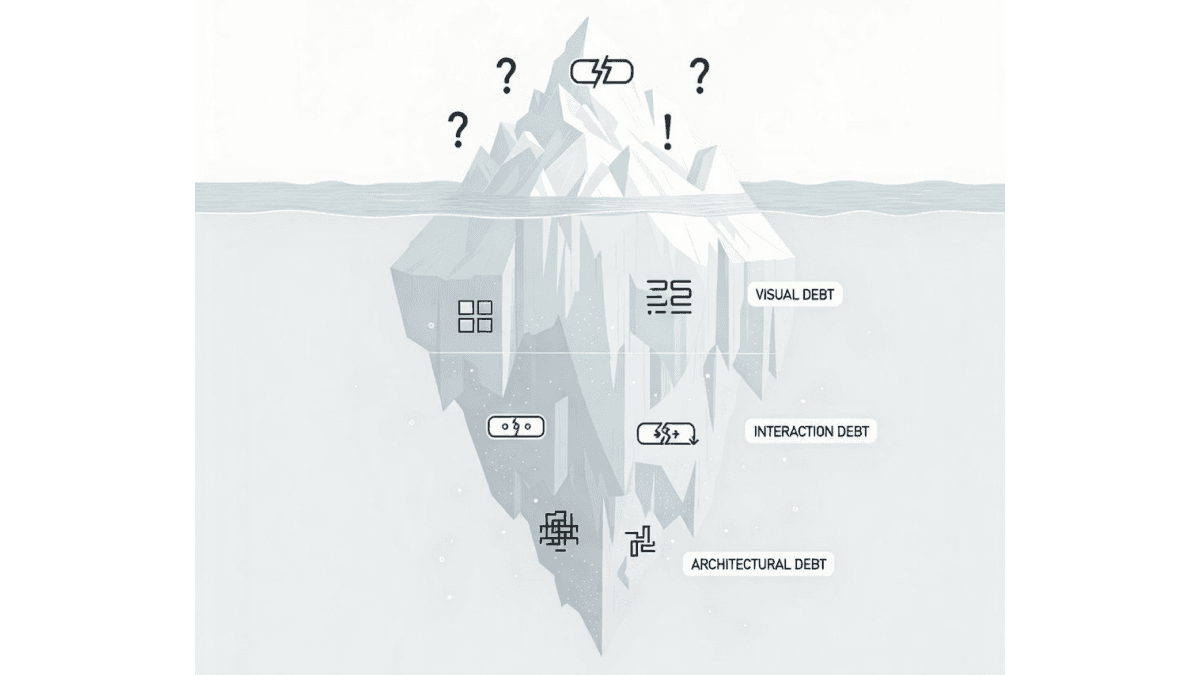
As UX debt grows, the digital product becomes harder to use and more expensive to maintain. A UX audit serves as the diagnostic tool to identify this debt and outline a strategy for repaying it before it severely impacts business performance.
Why Growing Businesses Need a UX Audit
Investing in a UX audit is not merely a design initiative; it is a strategic business requirement. The findings from an audit directly influence key performance indicators, operational efficiency, and revenue generation.
1. Measurable Improvements in Conversion Rates The most direct benefit of a UX audit is the optimization of conversion funnels. Research indicates that 88% of online consumers will not return to a website after a poor user experience [1]. By identifying where users drop off and simplifying those specific interactions, businesses can significantly increase conversions. A well-documented historical example involves a major e-commerce platform that discovered a mandatory "Register to Continue" step was causing massive cart abandonment. By replacing the registration requirement with a simple "Continue as Guest" button, the company increased purchases by 45%, generating an additional $300 million in annual revenue[2].
2. High Return on Investment (ROI) The financial return on UX improvements is substantial. According to Forrester Research, every $1 invested in UX design yields a return of up to $100, representing an ROI of 9,900%. Furthermore, companies that prioritize design experience 32% higher revenue growth and 56% higher total shareholder returns compared to their competitors [3].
3. Significant Reduction in Development Costs Fixing design errors after a product has been launched is highly inefficient. Addressing usability issues during the research and prototyping phases is up to 10 times cheaper than fixing them during development, and up to 100 times cheaper than correcting them post-release. A UX audit prevents businesses from wasting capital on developing features that users find confusing or unnecessary.
4. Mitigation of Business Risk Poor UX can lead to catastrophic operational errors. For example, in 2020, Citibank accidentally wired $900 million to creditors due to an outdated, overly complicated loan management interface [1]. The interface required a confusing three-step process with obscure fields, leading multiple employees to misinterpret the screen. A UX audit identifies these critical usability risks, ensuring that complex workflows are clear and error-proof.
5. Decreased Customer Support Volume When users cannot figure out how to use a product, they turn to customer support. High volumes of support tickets regarding basic tasks are a primary indicator of UX failure. By redesigning confusing interfaces based on audit findings, businesses can drastically reduce support inquiries. For instance, simplifying a digital onboarding flow can prevent thousands of monthly support tickets, leading to immediate operational cost savings.
When Should a Business Conduct a UX Audit?
A UX audit is highly recommended under the following circumstances:
- •Stagnating or Declining Metrics: When conversion rates drop, bounce rates increase, or user retention falls without a clear technical explanation.
- •Prior to a Major Redesign: Before investing in a complete product overhaul, an audit ensures the team understands exactly what is failing, preventing the accidental removal of features that currently work well.
- •After Rapid Feature Expansion: When multiple new features have been added over time, an audit is necessary to ensure the overall architecture remains logical and consistent.
- •High Support Ticket Volume: When customer service teams are overwhelmed with "how-to" questions from users.
The UX Audit Process
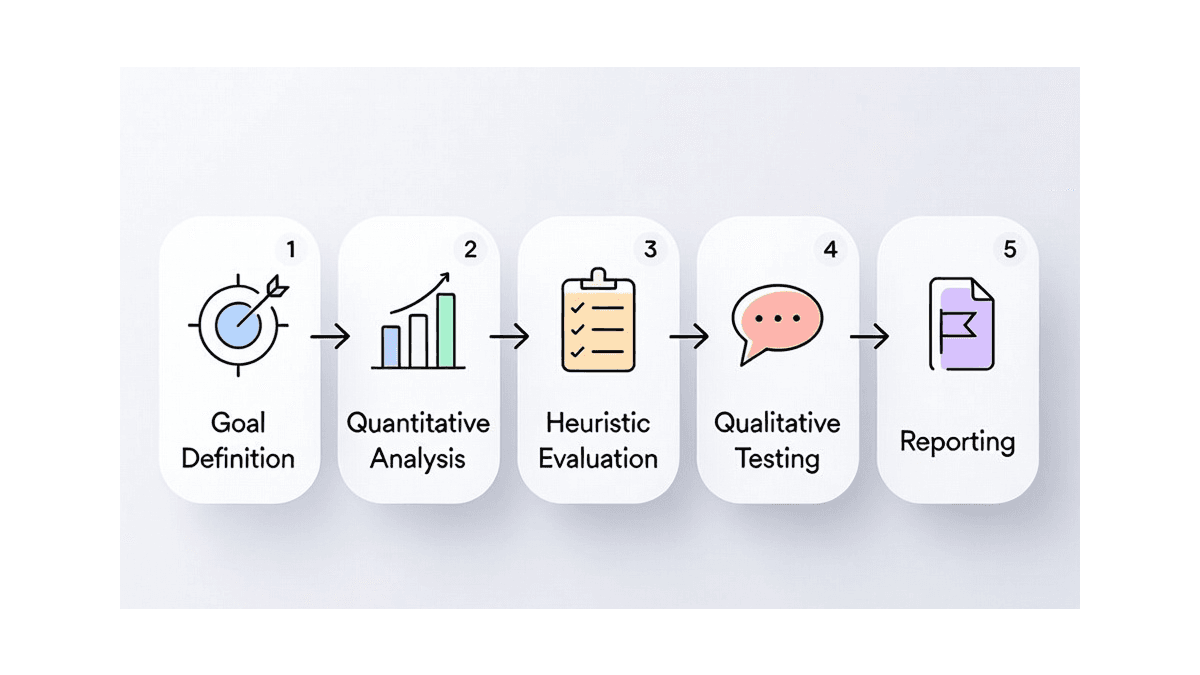
A professional UX audit relies on a structured methodology that combines quantitative data and qualitative research.
1. Goal Definition and Metric Alignment The process begins by aligning the audit with specific business objectives, such as reducing checkout abandonment or increasing software adoption. Key performance indicators (KPIs) are established to measure the success of future design changes.
2. Quantitative Data Analysis Auditors analyze hard data from platforms like Google Analytics, Mixpanel, or Hotjar. This involves tracking metrics such as task success rates, drop-off points, average session durations, and error rates. Heatmaps and scroll maps are used to visualize exactly where users click and how far they scroll.
3. Heuristic Evaluation UX experts systematically review the product interface against recognized usability standards, most notably Jakob Nielsen’s 10 Usability Heuristics. This step identifies structural flaws such as poor error prevention, lack of system feedback, and high cognitive load.
4. Qualitative User Testing To understand the "why" behind the data, auditors observe real users interacting with the product. Through moderated or unmoderated usability testing, researchers note moments of hesitation, confusion, and frustration. User interviews may also be conducted to gather direct feedback on user expectations and pain points.
5. Reporting and Actionable Recommendations The final deliverable is a comprehensive report that categorizes issues by severity (critical, major, minor) and provides prioritized, actionable solutions. The recommendations focus on changes that require the least development effort while delivering the highest business impact.
Conclusion
A UX audit is an essential strategic tool for any growing business. As digital products evolve, the accumulation of UX debt is inevitable. Without regular evaluation, user interfaces become cluttered, navigation becomes confusing, and businesses lose revenue to unnecessary friction. By utilizing data and expert analysis, a UX audit removes guesswork, allowing companies to make targeted improvements that boost user satisfaction, lower operational costs, and drive sustained business growth.
Let’s talk about how to transform your business. Ready to build great products and eliminate user friction? At Rootcode, we help teams audit, design, and implement accessibility and usability improvements that meet the highest global standards. From identifying hidden usability gaps to delivering inclusive, high-performing digital experiences, we support you every step of the way.
Share this article:
Räägime sellest, kuidas oma ettevõtet ümber kujundada.



Rootcode EU
Sakala tn 7-2,
Kesklinna linnaosa,
Tallinn,
Harju maakond,
10141, Estonia

Rootcode Sri Lanka
25/M1, 25,
St. Anthony's Mawatha,
Colombo 00300,
Sri Lanka
+94 112 574 572






© 2026 Rootcode. All Rights Reserved